DHJ Quick Take: Dallas Mavericks Hire Masai Ujiri
- “I Hope to Bring Calm”: Masai Ujiri’s arrival marks a definitive end to the chaotic post-Luka era. By emphasizing “calm” and “winning” in his Tuesday introduction, Ujiri signaled a move away from the high-volatility decision-making that has defined the front office since Nico Harrison.
- Process Over Impulse: While Jason Kidd’s future is under a “head to toe” evaluation, Ujiri notably pointed to his history with George Karl (three years) and Dwane Casey (five years) to show he doesn’t just immediately let coaches go. He is prioritizing a deliberate meeting with the staff—including familiar faces like Jay Triano and Popeye Jones—before making any final determinations.
- The Cooper Flagg “Flag”: Ujiri confirmed what many suspected: the presence of Cooper Flagg was the “deciding factor” in his return to an NBA front office. Ujiri’s vision involves shifting Flagg into a primary playmaker role, envisioning a roster of shooters and elite floor-spacers—like a healthy Kyrie Irving—to maximize the generational talent’s impact.
- Healing Through Winning: Addressing the “lingering healing process” of the Luka Dončić trade, Ujiri used a saying (“When kings go, kings come”) to reframe the franchise’s trajectory. With the NBA Draft Lottery set for May 10 and the Mavericks holding a 6.7% chance at the No. 1 pick, Ujiri is already looking to pair Flagg with another blue-chip asset to complete the turnaround.
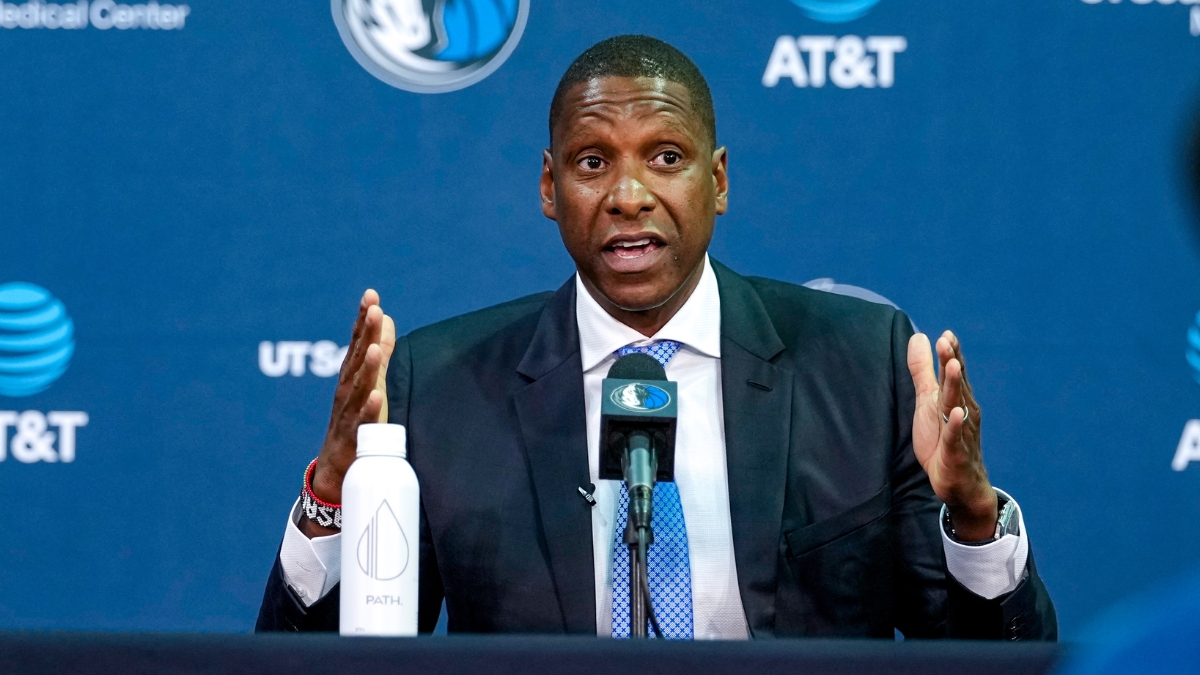
DALLAS — The Dallas Mavericks held the introductory press conference for new president of basketball operations and alternate governor Masai Ujiri on Tuesday, with the longtime NBA executive addressing local media for the first time since taking the job. Ujiri did not commit to Jason Kidd returning as head coach next season, framed Cooper Flagg as the deciding factor in his decision to come to Dallas, and acknowledged the lingering healing process surrounding the Luka Dončić trade.
Ujiri sat alongside Mavericks Governor Patrick Dumont for roughly an hour and fielded questions on a wide range of topics, from his evaluation timeline to the kinds of players he plans to build around Flagg. He opened his remarks by thanking Dumont and his family, briefly pausing to settle his young son, who had walked up to the lectern.
“To come to this storied organization, the Dallas Mavericks, come back to the NBA, it’s a blessing,” Ujiri said. “I’m honored and humbled to have this very unique opportunity.”
He then named the two things he intends to bring to the role, leading with a word that points directly to the public turbulence of the past year before adding the on-court goal that follows.
“I hope to bring calm. I hope to bring winning,” Ujiri said. “Yes, we want to get back to winning. This is a winning organization. I know the fan base wants that. I know the organization wants that. I know leadership wants that. I know the NBA wants that. I’m hoping, and I’m praying, and that’s to tell you guys that I’m here, and I know that winning is my drive, and winning is going to be the drive of this organization.”
Dumont, in his opening remarks, framed Ujiri’s hire as a marquee organizational addition built around championship pedigree, recruiting reach, and charitable work, signaling that the front-office reset is meant to be measured by all three.
“This is a big day for the Dallas Mavericks,” Dumont said. “Masai is a leader with experience, with vision, with great charity for the communities in which he lives and operates. He’s known to do great charitable works in Africa. He’s known to recruit great players worldwide, and he has a championship pedigree, and he’s now in the Dallas Mavericks family.”
Masai Ujiri Did Not Commit to Jason Kidd Returning as Head Coach
The most newsworthy moment of the press conference came on the question of Kidd’s status. Ujiri did not offer the kind of full-throated endorsement that typically accompanies a presumed continuity hire, instead acknowledging Kidd’s Hall of Fame résumé and pivoting almost immediately into evaluation language. He confirmed he had spoken to Kidd by phone the day before and emphasized that the in-person meeting still had to happen.
“I had a conversation with Jason Kidd yesterday,” Ujiri said. “I’m going to meet with Jason Kidd, hear his thoughts on everything. Another Hall of Fame player, has done a great job. But we’re going to look at this thing from head to toe. That’s the right way to look at an organization and evaluate in every single way that we can.”
Pressed on whether the answer left the door open to a coaching change, Ujiri pointed back to two specific historical comparisons of his own. Both of the head coaches he cited, George Karl in Denver and Dwane Casey in Toronto, were ultimately replaced after multi-year evaluations, with Casey winning Coach of the Year in his final season before being let go. By choosing those two examples, Ujiri implicitly acknowledged that even his retained head coaches eventually go through the same process.
“If you go back to my history, I’ve done the same thing everywhere I’ve been and been in this position,” Ujiri said. “I went to Denver, George Karl, and was there for three years. Went to Toronto, inherited Coach Casey, he was there for five years. So there’s no way to read this. I have to follow a process here, and I’m excited to meet.”
He added that the conversation with Kidd is not just on his to-do list. It sits at the top of it. He also referenced assistant coaches Popeye Jones and Jay Triano, both of whom Ujiri has previous working relationships with from his Toronto tenure.
“The priority is to meet with Coach Kidd and his coaching staff,” Ujiri said. “I know Popeye is here. I’ve talked to Jay Triano, all these guys I’ve worked with. I’m looking for a good transition here and to make good decisions as we go.”
The presence of Phil Handy on the Mavericks’ coaching staff is one of the cleanest threads connecting Ujiri’s Toronto tenure to his new role in Dallas. Handy was on the Raptors’ bench during the 2019 championship run and worked directly with the kind of young, championship-level talent that Ujiri now hopes to develop in Flagg and the Mavericks’ younger core. His track record there includes Kawhi Leonard, Kyle Lowry, Fred VanVleet, and Pascal Siakam. Ujiri’s praise was specific to Handy’s work ethic, not just his résumé.
“He’s one of the best player development coaches that you can have,” Ujiri said. “I know the great work he did with Kawhi, with Kyle Lowry, very young players at the time, Fred, Pascal, all those guys. He puts in the work. It’s 24/7. You come to the facility at night, he’s in there with them. I truly believe that he has this special connection with players and how he develops young players.”
Cooper Flagg Was the Deciding Factor in Masai Ujiri Taking the Job
Ujiri made it clear that Flagg’s presence was the reason he agreed to come back to an NBA front office after a year away. The argument he laid out was structural rather than sentimental. When asked why he picked Dallas, he cited the league’s other young cornerstone players already entrenched with their teams to make the point that competing in the modern NBA without a generational anchor is nearly impossible.
“When I met with him, I also told my boy Robbie, who is here, who works with me on all my business and personal side,” Ujiri said. “I said: You got Wembanyama the next 15 years. Luka, next 10, 12, 15 years. Anthony Edwards, 10, 12, 15 years. Shai, 10, 12, 15 years. Who else we got? Jokič, five, seven, how many years? How many guys have I mentioned? I’m forgetting guys. Now you have to convince me that I have to beat all those guys? You’ve got to come with something in your pocket. And in his pocket, he had Cooper Flagg. And I said yes.”
He returned to the same theme later in the press conference, framing Flagg in language that distinguished him from a typical high-lottery prospect. The phrase “planted a flag here” was a deliberate play on Flagg’s name and a positioning of him as the through-line for everything else the franchise will build.
“The one difficult thing to find anywhere, anywhere in sports, is a generational player, and we have one,” Ujiri said. “We’ve planted a flag here. We have one player here that can turn everything, and it is so hard to find in sports.”
The story behind how Ujiri ended up with Flagg also added a layer to his answer. Last year’s NBA Draft Lottery did not break Toronto’s way. The Raptors fell from the No. 6 slot to No. 9, a moment Ujiri described while wearing the same blue blazer he had hoped would bring better luck. He recounted scouting Flagg at a Duke practice that spring and trusting that the player would eventually land in his orbit, even after the lottery did not deliver him to Toronto.
“I went to watch him in practice. I’m watching this guy, arms are this long, his feet quick, at Duke,” Ujiri said. “We get to the draft, I got my blue blazer on, and I’m hoping to jump from six to one. I jumped from six to nine. But you know what? God said I was going to get that guy. And I got him. I got him here, and I’m going to do everything in my power, anything in my power, to make that kid’s family great.”
Building Around Cooper Flagg
Asked what types of players he plans to surround Flagg with, Ujiri described a roster vision built specifically around treating Flagg as a primary playmaker rather than a wing finisher. The implication is significant. Ujiri is not envisioning the kind of supporting cast typical for a 19-year-old forward, in which a veteran ballhandler runs the offense and the rookie plays off the action. He wants the offense to flow through Flagg, and he wants the rest of the roster to space the floor and finish around him.
“Shooters, athletic players, the best possible players that we can find to make the game a little bit easier for him, space the floor, and have him play as a playmaker,” Ujiri said. “I think Jason Kidd has done an incredible job putting the ball in his hands. We’ll continue to figure out ways to bring these players to make him better.”
He also spoke directly to the structural difficulty of building rosters in the current NBA, where free agency has cooled, the second apron places hard limits on how heavily teams can spend, and the league is rolling out new draft rules to discourage tanking. Asked how he plans to approach a team with limited future first-round picks in that changing competitive landscape, Ujiri treated the constraints as an accepted fact rather than something to complain about.
“In terms of building our team, we are going to turn it every single way,” Ujiri said. “Free agency is kind of a little bit dead in some kinds of ways, and the new rules now coming in with the draft and the whole tanking issue that we’ve had that the league is trying to solve, I think it’s good that the league solves this issue, because some of the games this year were not fun to watch.”
Ujiri pointed to a specific basketball reason the future Flagg and Kyrie Irving pairing should work, beyond the obvious talent overlap. Irving’s preference for playing off the ball is what makes the fit clean. Flagg can run offense as a primary creator, Irving can play in space as a scorer and secondary creator, and neither has to compete for the same touches. Irving missed all of Flagg’s rookie season recovering from injury, which is why the partnership has yet to be tested.
“I dream like you dream,” Ujiri said. “All of us dream. I can’t wait. I want to see that. If Kyrie Irving is not one of the best players, the best ball handler in the game. His experience, his championship flair. I’m excited to see that. His injury was unfortunate, but I know he’s moved past that. I think it’s going to be pretty cool, and I know it’s going to help Cooper, because Kyrie likes to play off the ball, too.”
Masai Ujiri Acknowledges the Luka Dončić Trade Healing Process
Ujiri did not avoid the trade that sent Luka Dončić to the Los Angeles Lakers, but he reached for an African proverb to reframe it. The choice was deliberate. Rather than litigate the past or assign blame, he validated the loss while immediately presenting the audience with a forward-looking image of Flagg as a “little prince” being raised to be a king. He used the word “healing,” but pivoted in the same answer to what comes next.
“There’s a healing process with that,” Ujiri said. “Luka is a Hall of Famer, future Hall of Famer. But that’s the past. I always say in Africa we say, ‘When kings go, kings come.’ And a king went, and we have a little prince here that we’re now going to turn into a king.”
Asked directly whether he would have made the trade himself, Ujiri declined to engage. He framed his answer around respect for everyone involved and drew a clean line between criticizing himself and criticizing his predecessors.
“We have to respect everybody and everything that’s happened here,” Ujiri said. “He is a Hall of Fame player, he’s gone, he will always be a Maverick. We’ll celebrate him in the best possible way, like we’re going to celebrate all the Maverick players and stars that have been here. But we have to move on. It’s not for me to start criticizing what anybody else is doing. It’s for me to criticize what I am doing, and worry about what I’m going to do.”
Dumont, asked separately whether the hire represented a final step in moving past the trade, used the same forward-looking language Ujiri had reached for, treating the question as already resolved.
“In my mind, it’s thinking about the future,” Dumont said. “I agree with all the remarks that Masai had about it. I’m looking for Masai now to help lead us to a championship, and also lead us to create a great team with great character, with the right focus.”
The Summer Ahead for the Dallas Mavericks
Ujiri’s near-term agenda is evaluation rather than overhaul. He repeatedly emphasized a desire to retain the staff already in place, framing his priority as identifying those who share the same focus on winning rather than imposing his own people.
The Mavericks finished the 2025-26 regular season at 26-56 and enter the May 10 NBA Draft Lottery holding the No. 8 odds, with a 29.0% chance to land in the top four and a 6.7% chance to come away with the No. 1 overall pick. Ujiri confirmed he will attend the lottery alongside Mavericks representatives and pointed to Mavericks legend Rolando Blackman, seated in the room, as the team’s good-luck symbol after Blackman represented Dallas at last year’s lottery, when the Mavericks landed the No. 1 pick.
“I’ll officially appoint him to go and deliver another number one pick,” Ujiri said.
Asked about the to-do list waiting for him, Ujiri described a transition rather than a clean break. He had not anticipated taking a job this offseason and had outside commitments to wrap before fully stepping into the role.
“To-do list, honestly, is evaluation,” Ujiri said. “I have a transition period here with some of the stuff that I was doing. I have to go take care of a few things, because there were times when I didn’t anticipate even taking a job this year. So tons of stuff to unpack short-term, long-term, really evaluating, meeting people, meeting everybody, meeting the staff here.”
He also indicated he plans to lean on the existing structure rather than reset it, naming continuity as a priority across every department.
“I want to keep the great people that think about winning,” Ujiri said. “It’s that simple for me. The focus now is not any distraction. The focus is winning in every single department we have, whether it’s medical, coaching, players, everything, and I can get the sense that everybody really wants to win.”
Asked about his conversations with the two interim general managers who had also been candidates for the job, Matt Riccardi and Michael Finley, Dumont thanked both and indicated their futures with the organization would be addressed in the broader staff conversations Ujiri plans to have.
“First off, I want to thank Matt and Finn for the work that they did across this year,” Dumont said. “They did phenomenal work. As Masai spoke about, he’s going to speak to everyone and talk to them about the future of the organization, and we’ll go from there.”
Patrick Dumont Reaffirms Plans for a New Mavericks Arena Inside Dallas
Dumont also used the press conference to reaffirm the Mavericks’ commitment to building a new home inside the city limits of Dallas. The project, which has been working its way through municipal channels with Mavericks executive Rick Welts leading the franchise’s side of the discussions, is being framed as a multi-decade investment rather than a short-term venue change.
“Our goal is to build a new home for the Dallas Mavericks that will be our home for the next 40 years inside the city of Dallas,” Dumont said. “So we’re committed to the city of Dallas. We want to create something that’s great for our fans and that is the home of our team for the future. We have Rick Welts. We’re working with the city right now, and we’re very excited to do that.”
How Patrick Dumont and Masai Ujiri Connected
The story of how Ujiri ended up in Dallas stretches back four months, to a phone call from Dumont in December. Dumont made the first move and treated the search as a targeted recruitment of one specific candidate rather than a wider front-office process. The detail he chose to share, that Ujiri’s availability made the call obvious, was less about the Mavericks’ need than about the rarity of the opportunity.
“I definitely called him first,” Dumont said. “I think it was really important to find the right person, and when someone like Masai is available, that’s the first call.”
The first in-person meeting was originally a one-hour lunch. It turned into a five-hour conversation that bled into dinner, with the two leaving the restaurant only after the owner, a friend of Dumont’s, let them stay past closing without saying a word. Ujiri offered the story not just as an anecdote but as evidence of the alignment he was looking for, and he made a point of noting that Dumont checked his phone exactly once in five hours.
“I have a five-hour meeting with Patrick,” Ujiri said. “Our wives are looking for us. He checks his phone one time in a five-hour meeting. One time. My wife is looking for me. His wife is looking for him. They kicked us out of the restaurant. His friend owns the restaurant. He doesn’t even say anything because his lunch is over. They have to change it to dinner. We go sit outside, and we continue talking.”
Dumont described the substance of those early conversations as deliberately broad, covering values and personal background before getting to basketball. The emphasis on charitable work and Africa reflects Ujiri’s foundational identity as much as his executive résumé.
“It’s about getting to know Masai as a person,” Dumont said. “We spent a lot of time in our first meeting talking about life, talking about our values, what we felt was important, charitable work, why Africa was so important to him, the trajectory of where he thought he could take this team.”
He added that the alignment between owner and executive on the long-term direction was non-negotiable, and that the multiple follow-up conversations were designed specifically to test for daylight between them.
“It was really important to be able to show that there’s no daylight between us, that we have complete alignment, that we understand what the objective is,” Dumont said. “We talked about winning. We talked about the success of the organization, building around Cooper, building around young talent and experienced veterans with the flexibility that we have, and making this team a champion.”
Masai Ujiri’s Year Away From the NBA
Ujiri’s year out of an NBA front office was not passive observation. He spent significant time on his nonprofit work in Africa, joined the WNBA’s Toronto Tempo ownership group, and watched the league with the specific intent of identifying gaps that could be turned into a competitive advantage. The two areas he came back focused on, medical infrastructure and off-court mental health support for young players, are not the kind of things typically discussed at introductory press conferences, which is partly why he raised them.
“One of the things I think we have to get better here is how we figure out medically what we do,” Ujiri said. “I try to study the fast game in the NBA, and how you put players around a player like Cooper Flagg, how you innovate in this way. Things you do off the court to help young players, like mentally. I think we don’t pay enough attention to this in the NBA, and really focus on their focus, and help them through this because a lot of times these youth are coming from different environments. They are still learning. They are still young.”
He also said the year away reinforced how much he missed the competitive part of the job. The taste of winning a championship is what he wanted to feel again, and the framing he used, that winning one means wanting another, explained as much about his motivation for returning as anything else he said.
“That drive for winning, what I found out is if you win one, you want to win again,” Ujiri said. “Everybody here, the passion of what happens here and how we feel in healing is because you want to win again. I want to win again. Sport is about winning. Win on the court, win off the court, and as we do it, bring people along. What I’ve learned is, man, I want to taste it again.”
Masai Ujiri’s Path Has Come Full Circle to Dallas
Asked to reflect on his earliest memories of the NBA, Ujiri offered an answer that doubled as a tour of his connections to the Mavericks specifically. The franchise’s history is woven through Ujiri’s own career trajectory in ways that are not coincidental. The people who hired him, mentored him, and shaped his scouting eye all have direct ties to Dallas. Don Nelson, Kiki VanDeWeghe, and Amadou Gallo Fall all came up in his answer, with Fall in particular standing out as a Senegalese-born former Mavericks scout who helped open doors for Ujiri early in his career.
“Full circle, the scouting and traveling around the world has brought me even back to the Mavericks,” Ujiri said. “So, Don Nelson. Kiki VanDeWeghe. The era of Dirk Nowitzki and Steve Nash. That was my time of growing up in the NBA, scouring the world and seeing Don and them helping you, or Amadou Gallo Fall, who’s an incredible friend, mentor, who brought me up in this business, worked here as an incredible scout with this organization, and director here. So it comes around.”
He also recounted his entry point into NBA front offices, hired in Denver alongside Jeff Weltman. VanDeWeghe, who was the Nuggets’ general manager at the time, would later resurface in Dallas years afterward as a development coach.
“Kiki VanDeWeghe hired me and Jeff Weltman,” Ujiri said. “They hired me in Denver to be a scout, my first job. And Kiki VanDeWeghe was in this gym developing players. So it goes way back.”
The most personal moment of the press conference came when Ujiri described what the journey has felt like from the perspective of a kid who once watched the league on grainy VHS tapes. He used the recurring image of Michael Jordan palming his head as Jordan walked into the room at NBA Board of Governors meetings. The small physical gesture from a global icon to a young African executive captured what the path has meant. He closed the answer with a philosophical thought that reframed his hire as part of something larger than basketball.
“Going back as a kid, you put on VHS, and it’s Larry Bird and Michael Jordan and all these guys,” Ujiri said. “And now I’m sitting down as an alternate governor in New York, and every time Michael Jordan walks into the room, he used to palm my head. He’d palm my head, and he’d walk to his seat, every time. Now you’ve been growing up and watching all these people, and now you get to know them. Sometimes I pinch myself, and I wonder why I was chosen to do this. And I know I figured the answer. The answer is all of us were chosen. Every single one of us in this world is chosen for something special, and we just have to find it, and I found basketball.”
What Patrick Dumont Has Learned as Dallas Mavericks Governor
Two questions to Dumont near the end of the press conference produced complementary answers about what the past two years have taught him. The first prompted a response about the structural ingredients of a successful NBA franchise.
“It starts with great leadership and great organizational focus, and having the talent on the team that all works together and rows in the same direction,” Dumont said. “And if you get that, great things will happen. And so that’s what Masai is here to do.”
The second was a direct ask about the highs and lows of Dumont’s tenure as governor. His answer narrowed in on a single lesson: that internal alignment matters more than any individual move, which read as a deliberate framing in light of the public criticism the franchise has absorbed recently.
“I think it has to do with communication and collaboration within the organization,” Dumont said. “Having the right leadership is key, but having those leaders work together with a common goal is what sets franchises apart. That to me is the big difference.”
Asked what he wanted to say to Mavericks fans, Dumont offered a message centered on the supporters who have stayed engaged through a difficult time.
“I want to thank our fans for being so passionate,” Dumont said. “I think we have the best fans in sport. I think they love the Dallas Mavericks — MFFL, right? And so it’s really important for us to put the right executives onto this team to create a championship.”
Ujiri’s own closing line, delivered in the team’s hiring announcement earlier in the day, was equally direct.
“We will win in Dallas,” Ujiri said.
More Mavericks Coverage on Dallas Hoops Journal
- ‘It Means Everything’: Dallas Mavericks Star Cooper Flagg Reflects On NBA Rookie Of The Year Award
- Cooper Flagg Wins NBA Rookie Of The Year, Joins Jason Kidd And Luka Dončić In Dallas Mavericks History
- ‘That’s What Paul Silas Did For Me’: LeBron James Draws Parallel Between His Rookie Role And Cooper Flagg’s
- ‘He Will Be Unstoppable’: Cooper Flagg’s Three-Point Statement Gives Blueprint For NBA Dominance
- ‘They’re Very Similar’: Jason Kidd Breaks Down The LeBron James Parallels For Cooper Flagg