The Dallas Wings looked poised to secure one of their most complete wins of the season, building a double-digit first-half lead with crisp passing and efficient shooting. But the Washington Mystics flipped the script after halftime, outscoring Dallas 61–37 over the final two quarters to leave College Park Center with a 91–78 victory on Sunday afternoon.
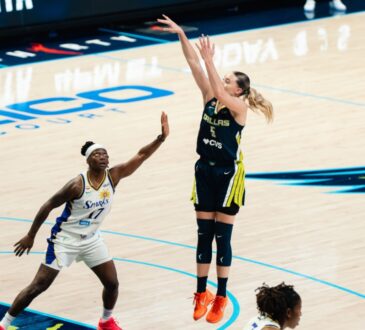
Paige Bueckers led the Wings with 17 points, three rebounds, three assists, two steals, and a block, tying Caitlin Clark for fifth in WNBA history for most consecutive double-digit scoring games in a rookie season (25) and Swin Cash for third in franchise history for most 15+ point games by a first-year player (19).
Bueckers, who appeared to grab at her back at times, downplayed the concern after the game.
“I’m feeling alright. Good enough to play,” she said. “I’m not gonna make any excuses, so I’m feeling all right.”
The Wings finished with seven players scoring eight points or more. In addition to Bueckers’ output, the Wings received 12 points from Arike Ogunbowale, Haley Jones added 11 points and four rebounds, and Luisa Geiselsöder scored 10. Maddy Siegrist recorded nine points and three rebounds, JJ Quinerly scored nine, and Myisha Hines-Allen totaled eight points, 11 rebounds, and five assists. However, Washington’s 61-point second-half surge overshadowed.
First-Half Ball Movement Showed the Blueprint
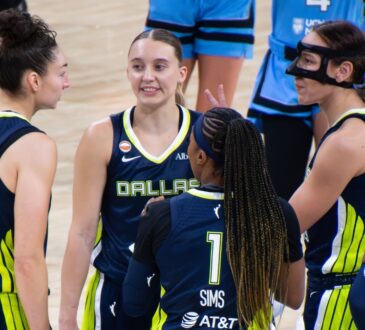
For the first time this season, Dallas started Grace Berger, Bueckers, Ogunbowale, Jones, and Geiselsöder. In her first career start, Berger quickly made her presence felt with assists to Geiselsöder and Hines-Allen for early three-pointers. Bueckers followed with the team’s fourth make from deep to force a Mystics timeout.
The Wings closed the opening quarter on a 9–0 run, shooting 60% from the floor and 80% from beyond the arc. By halftime, Dallas was shooting 60% from three, holding Washington to 35% shooting, and led by as many as 13.
Jones said the ball movement and spacing in the first half were exactly what Dallas needs to replicate more consistently.
“Offensively in the first half, the ball popped a lot more and moved better,” Jones said. “We did a really good job playing out of the empty side ball screen, but we didn’t go back to that in the second half as much. In the first half, we were still making mistakes, but I don’t think they were hitting as often, so you feel like you can get away with things. In the second half, they really capitalized on those mistakes. We’re great in transition, but we have to work on our half-court offense, and our intensity has to stay the same throughout the whole game.”
Geiselsöder agreed, adding that Dallas’ inability to get stops in the second half slowed the offense and prevented them from generating the same looks.
“I have the feeling that in the second half, we didn’t get stops, so we couldn’t run,” Geiselsöder said. “Our offense was slower, and we didn’t get the looks we wanted. If we move the ball, as Haley said, we get open shots — using the 24 seconds and getting a wide-open shot or a good look. We need to keep searching for the good shots and move the ball.”
Third Quarter Remains a Pain Point
The third quarter has been a problem all year for Dallas, and Sunday was no different. Washington opened the half with a 15–4 run to tie the game at 45–45, then took its first lead since the opening minutes on a Sonia Citron layup. Citron and Kiki Iriafen combined for 23 points in the period as the Mystics shot 78% from the field.
Koclanes said that when Dallas isn’t getting stops, it can’t generate the pace that makes its offense effective.
“We have to put 40 minutes together,” Koclanes said. “But when we get stops and can run in the open floor, we’re better. We need to get more stops, period. Even when the ball goes through the hoop, we have to generate the same pace and tempo and keep the ball moving. In the third quarter, we were taking the ball out a lot, and that slows you down.”
Jones credited the Mystics for making key adjustments.
“I think they did a really good job making the right adjustment out of our traps, and I don’t think we communicated enough on the backside to get there,” Jones said. “Frustrations on the offensive end led to poor shot selection across the board occasionally, which leads to their transition where they’re able to get a lot of points around the rim. They just had way too many offensive boards. In the past few games, we’ve out-rebounded the other team, so that was a big switch-up tonight.”
Geiselsöder agreed, pointing to defensive lapses.
“I think us being late on some rotations just means they can move the ball easily,” Geiselsöder said. “That’s what they did — they moved the ball really well and then hit easy layups under the basket or found the look they wanted. We have to be harder and better on defense.”
The flow of the game was also disrupted by constant whistles — 18 fouls were called in the third quarter alone. Siegrist said the stop-and-start nature made it hard to stay locked in.
“I mean, I think both ways… trying to think, I don’t want to get fined,” Siegrist said. “Both ways, I think they called us a ton of fouls, and it’s obviously hard to get into a flow like that. We made a lot of our free throws, but just being able to take advantage and not get as frustrated — I thought we let it affect us a little bit too much. Sometimes they’re going to make tough calls that don’t go your way, and we just have to be able to move on from that.”
For Bueckers, fixing the problem is about energy as much as execution.
“I think we just have to come out with more intensity and not take our foot off the gas, and play an entire 40 minutes,” Bueckers said.
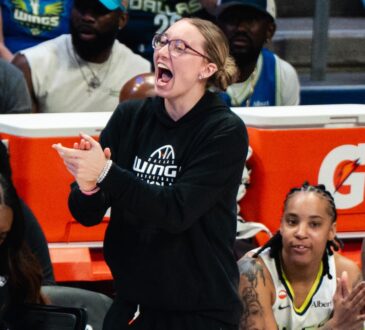
Head coach Chris Koclanes said his halftime message was to separate offense from defense.
“We’ve got to focus on getting stops regardless of what’s happening on the other end,” Koclanes said. “If the shots aren’t falling, you can’t let that bleed into your defensive effort. We’ve got to be able to sustain our intensity.”
Consistency and Action Over Words
The Mystics continued to dictate the pace in the fourth, going on a 20–6 run to put the game out of reach. Citron and Emily Engstler combined for 12 points in the period as Washington shot 82% from the floor. JJ Quinerly led Dallas in the final frame with six points off the bench.
Bueckers said Dallas knows what needs to change but hasn’t yet translated that into consistent play.
“Just being about action, not words,” Bueckers said. “We know what to do, so just doing it.”
Siegrist shared the same sentiment, pointing to the need for defensive reliability regardless of shooting performance.
“I don’t think so, or else we’d have a lot more wins,” Siegrist said when asked if the team was executing its game plan. “As a group, it just has to be more consistent on both sides of the ball. You’re not always going to shoot well, but you’ve got to be consistent defensively. And you’ve got to be confident enough to take the next shot. You might miss a layup or a three, but your teammates are working so hard to get you that next one, so you’ve just got to step into it confident.”
Koclanes credited Washington’s relentlessness while noting Dallas’ missed opportunities.
“That’s what they do — they pound the ball downhill, they’re relentless, and Kiki was big on the boards,” he said. “Some of it was self-inflicted. We missed a lot of layups in the first half, and that 10-point lead could’ve been 20. But you can’t give up 60 points in the second half and expect to win.”
Grace Berger’s Growing Comfort
Berger has taken on more responsibility as a facilitator and secondary scorer. Sunday marked her first career start, and she logged extended minutes for the third consecutive game. She missed all five of her shots and went scoreless, but she did record two assists and two steals in 19 minutes. She provides a point guard skill set that the Wings have sought next to Bueckers.
Before the game, Koclanes said Berger’s adaptability has been valuable in stabilizing the backcourt.
“Grace has been ready when her number’s called, and she’s made the most of the opportunities she’s earned,” he said. “She plays with poise, sees the floor well, and helps us get into our sets.”
Berger said the call to rejoin the team earlier this month came after some anxious waiting.
“I was hoping I’d be able to come back, and when I got the call, I was super excited,” Berger said.
She also reflected on the challenge of her fluctuating role.
“It was a little weird. I just got a three-day vacation at home,” Berger said with a smile. “I watched their game on TV and was sad I wasn’t there.”
Maddy Siegrist’s Role and the Team’s Potential
Siegrist said her mindset since returning from injury has been to provide steady contributions in whatever role she’s asked to play. She’s averaged 12.3 points per game since returning from her 18-game absence.
“For me, coming off injury, I just wanted to be better than I was before,” Siegrist said. “I wanted to play consistent every single night, whether I’m coming off the bench or starting. I want to be someone we can consistently rely on on both sides of the ball. If that’s coming off the bench, then it’s about being that spark and trying to get as many extra possessions for our team as possible.”
She said the Wings’ strong start against Washington is a reminder of what they are capable of when everything clicks.
“We’ve shown in spurts that we can play very well,” Siegrist said. “Defensively, we can be disruptive and get out in transition, and offensively, we can move the ball side to side and generate open looks. That’s a positive. Like Paige said, it’s tough to see the positives when you’re in it, but we just have to get over the hump.”
Adjustments and Player Development
The Wings face questions on both offense and defense amid a five-game losing streak.
One issue the Wings faced was a challenge getting Bueckers involved down the stretch. Koclanes said Washington’s aggressive defense in the second half was a big reason why Bueckers saw fewer touches.
“They were aggressive with her at the point of attack, bringing two to her and challenging other people to beat them,” Koclanes said. “Citron top-locked and was physical. That makes it hard for her to get touches. We try to get her off the ball and on the move. There are lots of factors. Credit to Paige — she’ll keep fighting and moving to help the team win.”
Looking ahead, Koclanes said improved execution will be key in the final stretch. There is room for growth in effort level, but establishing the proper defensive identity has been a challenge. With limited practice time and a lack of continuity, it’s been challenging to determine if heavily utilizing a base scheme is the right approach or if they can manage to improve by showing different looks.
“We can play harder and more consistently,” Koclanes said. “Defensively, it’s a balance between getting good at one thing and having multiple coverages. With a young group, that’s hard. We need to give more effort regardless of coverage and keep scrambling for each other.”
He added that his leadership approach is to stay steady for the group.
“Never too high, never too low,” Koclanes said. “They need an anchor. I love the people in our locker room — they’re about the right things. I’m learning when to hold people accountable in different ways, and that every player responds differently.”
Focus on Turning Messages to Results
With a month left in the regular season, Bueckers said the focus has to be on translating conversations into results.
“There’s only so much we can talk about,” Bueckers said. “We’ve had these conversations after almost every game, so right now it’s all about action. I think I can be better at setting that tone.”
Bueckers also highlighted the importance of maintaining the same energy level throughout the game.
“In the second half, they really capitalized on those mistakes,” she said. “We’re great in transition, but we have to work on our half-court offense, and our intensity has to stay the same throughout the whole game.”
Veteran forward Myisha Hines-Allen said the team remains connected despite the challenges of a difficult season.
“We’re in every game, and the locker room is strong. That’s never been an issue,” Hines-Allen said. “We focus on getting to know each other beyond basketball, which shows on the court. We have lapses because we’re new to playing together, and that’s why we can’t always finish games. But we like each other, the vibes are good, and we know there’s room for improvement—especially in closing games.”
Hines-Allen also highlighted the importance of playing with sustained energy.
“We can’t come out flat and then try to turn it on later,” Hines-Allen said. “It’s about bringing that energy from the tip and keeping it through all four quarters.”
Dallas will now travel to Indiana to face the Fever for the final time this season on Tuesday at 6:30 p.m. CT. The game will air nationally on ESPN.
More Dallas Wings News & WNBA Rumors
- WNBA News: “Paige Will Be a Unifier”: Curt Miller Details Dallas Wings’ Roster Plan Around Paige Bueckers
- WNBA News: “We’re Really Excited About Arike”: Curt Miller Outlines Arike Ogunbowale’s Prominent Role in Dallas Wings’ Plans
- WNBA News: “We Need to Put Two Halves Together”: Dallas Wings’ Rally Falls Short Without Paige Bueckers in Loss to New York Liberty
- WNBA News: “We’re Taking a Little Bit of the OKC Model”: Curt Miller on the Dallas Wings’ Roster Approach Around Paige Bueckers, DiJonai Carrington Trade and More
- WNBA News: “Preparing to Be in the Playoffs”: Diamond Miller Settling Into Role With Dallas Wings
- WNBA News: Dallas Wings’ Paige Bueckers Earns Second Consecutive WNBA Rookie of the Month Honor