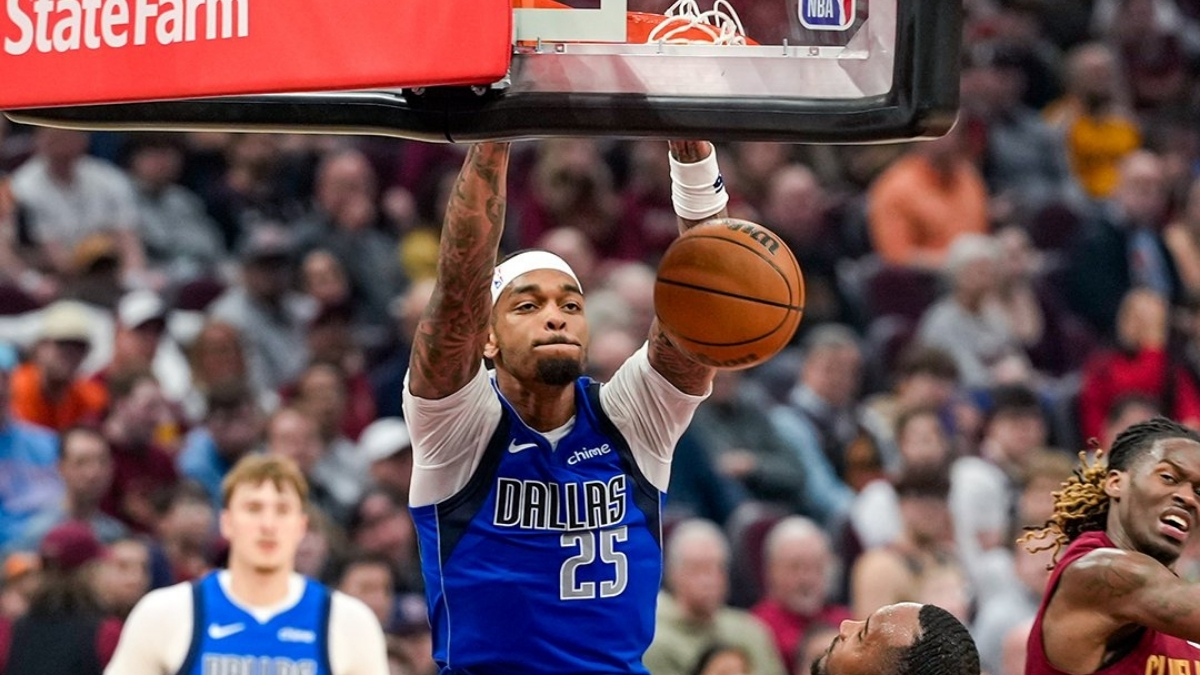
Jason Kidd had a problem heading into Sunday’s rematch against the Cleveland Cavaliers. Daniel Gafford was resting, Dereck Lively II was out for the season, and the Dallas Mavericks had just been physically dominated at home two nights earlier. His solution was unconventional, starting 6-foot-7 P.J. Washington at center, but it was instrumental in securing a 130-120 victory.
Washington put up 20 points on 8-of-16 shooting, 11 rebounds, 5 steals, and a block — a performance matched only by Mark Aguirre and Roy Tarpley in Mavericks history. In the first half alone, Washington racked up 14 points, 6 rebounds (5 offensive), and 5 steals before the break. Only Jerome Williams and Tom Gugliotta had achieved those stats in a single half since the play-by-play era started in 1996-97.
What the lineup did to Cleveland’s defense had a trickle-down effect on the Mavericks’ offense. Dallas finished with 35 assists, shot 53% from the field and 50% from 3-point range, and outscored Cleveland by 10 in a game they trailed by a point at halftime.
The Idea Behind the Dallas Mavericks’ Lineup Change
The strategy behind the lineup change was straightforward. Kidd wanted more 3-point attempts and a faster pace — and he thought Washington at the five was how to get them. It also provided more defensive versatility to help contain Evan Mobley on the roll, as well as Donovan Mitchell and James Harden in space.
“We were looking at whether we could generate more threes. We thought with him at the five we could do that,” Kidd said. “With Ryan and him being able to generate threes and play with pace, I thought the energy was good, and the ball was moving with that first group.”
Washington understood immediately what his role at the five would require and why it created problems for opposing defenses.
“I think I’m a mismatch. I can create for others, I can pass, I can set screens and pop. It’s not really what happens every day in the NBA — it’s a lot of rolling centers,” he said. “Me at the five popping opened up a lot of space on the floor for us to get some closeouts and ball reversals to get some good shots. I think it was good for us.”
Naji Marshall put it simply.
“A smaller and quicker lineup. Play faster. That’s really about it,” he said.
Guard-to-Guard Screens Create Advantages
The spacing Washington created at the five enabled something else entirely — a guard-to-guard screening game that Cleveland had no clean answer for all afternoon.
The concept works because of how Washington’s positioning affects the defense. Without a traditional center stationed near the basket, guard-to-guard screens are easier to navigate by having space to hunt mismatches by bringing up weaker defenders into the action. With Washington stationed above the break or in the corner as a legitimate shooting threat, the typical safety net that a shot blocker provides is diminished. When a guard runs off a screen, the big defending Washington cannot rotate toward the ball without leaving a spacing threat wide open. When he stays, a mismatch is created in the ball-screen action.
Dallas had seen this concept work against them on Friday. Cleveland used similar screening actions to generate open looks and dribble penetration that the Mavericks couldn’t contain. Kidd studied the film, identified the blueprint, and handed it back to Cleveland on Sunday.
“Being able to look at what Cleveland did to us, we felt maybe we could do that tonight. Playing P.J. at the small five and being able to stretch — having him in the corner or above the break — trying to get Mobley away from the basket, because he’s a great defender,” Kidd said. “Understanding that small-ball lineup was really good, and hopefully we can build on this.”
Marshall explained what those actions looked like as one of the key ball handlers who pick the defense apart.
“Just put some defense at a disadvantage,” he said. “I think it’s really good for our guys, a lot of guys to get downhill, open up a lane, create a drop lane, be able to make reads for other guys like our shooters.”
Cooper Flagg broke down why the actions are so difficult to defend, regardless of the coverage called.
“That’s something we’ve worked on a lot throughout the year — finding mismatches in those actions. It’s hard to guard,” he said. “If they try to switch, you can roll out and get a pass over the top. If they switch, you get a matchup you like. If they don’t switch, you can get downhill. There are a lot of different options. Especially tonight we had a lot of like-sized guys out there, so just being fluid and playing fast was definitely to our advantage.”
Playing Faster, Moving Better
The downstream effect of all this spacing was pace. Dallas finished with 35 assists — 11 in the first quarter alone — and shot 53% from the field and 50% from 3-point range. The Mavericks looked nothing like the team that trudged through a 138-105 loss at home two nights earlier.
Marshall said the versatility of the smaller lineup also changed what Dallas could do defensively.
“Switch one through five. More physical, a little bit bigger when far. Rebounding and just getting out, playing fast,” he said.
Washington explained how his ability to switch across positions — something a traditional center cannot do — gave Dallas a defensive identity to match its offensive one.
“I thought we did a good job switching and trying to take the three-point shot away from them, forcing them to play inside the paint and contest and rebound,” he said.
Flagg said the pace the lineup generated was reminiscent of Dallas at its best earlier in the season.
“It’s great. I love when we’re in transition. I think there was a while where we were top five in transition points in the league. That’s the way we want to play. When we can get out and get easy ones, it gets you feeling good,” he said. “The ball was moving, everybody was getting touches. It was a much more fun way to play basketball.”
P.J. Washington Handles the Interior Challenge
The apparent concern with going small against a team that has Evan Mobley and a physical frontcourt is rebounding and interior defense. Washington answered both. His 11 rebounds were a direct response to that concern. Kidd singled out the rebounding as one of the most important contributions of the afternoon.
“Great hands. Maybe underestimated as a shot blocker. But again, being able to rebound the ball for us tonight — you look, he had a double-double,” Kidd said. “That’s something we’ve struggled with lately, being able to rebound the ball and giving up offensive rebounds. He really did a great job for us tonight.”
Washington said the mindset at the five was no different from any other position — compete, communicate, and make plays.
“Just trying to take the challenge. I felt like we had it going for us today. Just try to be in there, be a leader on both ends of the floor, talk, rebound, get in good positions, and just try to make plays,” he said.
On the offensive end, Washington’s activity in pick-and-roll coverage also gave Dallas something it lacked Friday. His 5 steals were the product of reading Harden’s tendencies and being aggressive at the point of attack.
“Just trying to be aggressive in pick-and-roll. I knew Harden was going to be looking for Mobley early, so just trying to put my hands in there and be active,” Washington said.
Flagg saw the adjustment as transformative on both ends of the floor.
“P.J. is such a versatile guy. He’s willing to do whatever it takes out there, and he’s so strong,” he said. “It helped us with our coverages and just flying around the court and speeding up on both sides of the ball. I thought that was huge tonight.”
Is This Sustainable?
The question that follows Sunday’s performance is whether the Mavericks have found something worth keeping — or whether this was a one-game solution built around a specific matchup.
Kidd’s answer suggested he sees real potential to build on it.
“Understanding that small-ball lineup was really good, and hopefully we can build on this,” he said.
Washington believes the concept has legs beyond one afternoon in Cleveland.
“It just shows us who we can be when we’re healthy and playing the right way,” he said. “We’re just trying to establish some unity and establish how we want to play. I think it was a good start for us tonight.”
With 14 games remaining and a roster that will continue to operate without Lively, the small-ball center experiment that started as a necessity Sunday may end up being one of the most intriguing tactical discoveries of the Dallas Mavericks’ season.
Latest Dallas Mavericks News & NBA Rumors
- NBA News: ‘I’m A Mismatch’: Dallas Mavericks Start P.J. Washington At Center, Stun Cleveland Cavaliers 130-120 Behind Cooper Flagg’s Historic Night
- NBA News: ‘Just Finding The Open Man’: Ryan Nembhard’s Impact Grows In Starting Role For Dallas Mavericks
- NBA News: Cooper Flagg Says He’s ‘Getting His Pop Back’ After Encouraging Performance Against Cleveland Cavaliers
- NBA News: ‘You Keep Firing’: Khris Middleton Erupts For 35 Points Off The Bench, Dallas Mavericks End Eight-Game Skid In Memphis
- NBA News: ‘It Was A Mistake’: Mark Cuban Regrets Hiring Nico Harrison As Dallas Mavericks GM
- NBA News: ‘We Just Couldn’t Make The Plays Down The Stretch’: Dallas Mavericks Fall To Atlanta Hawks 124-112, Extending Losing Streak To Eight