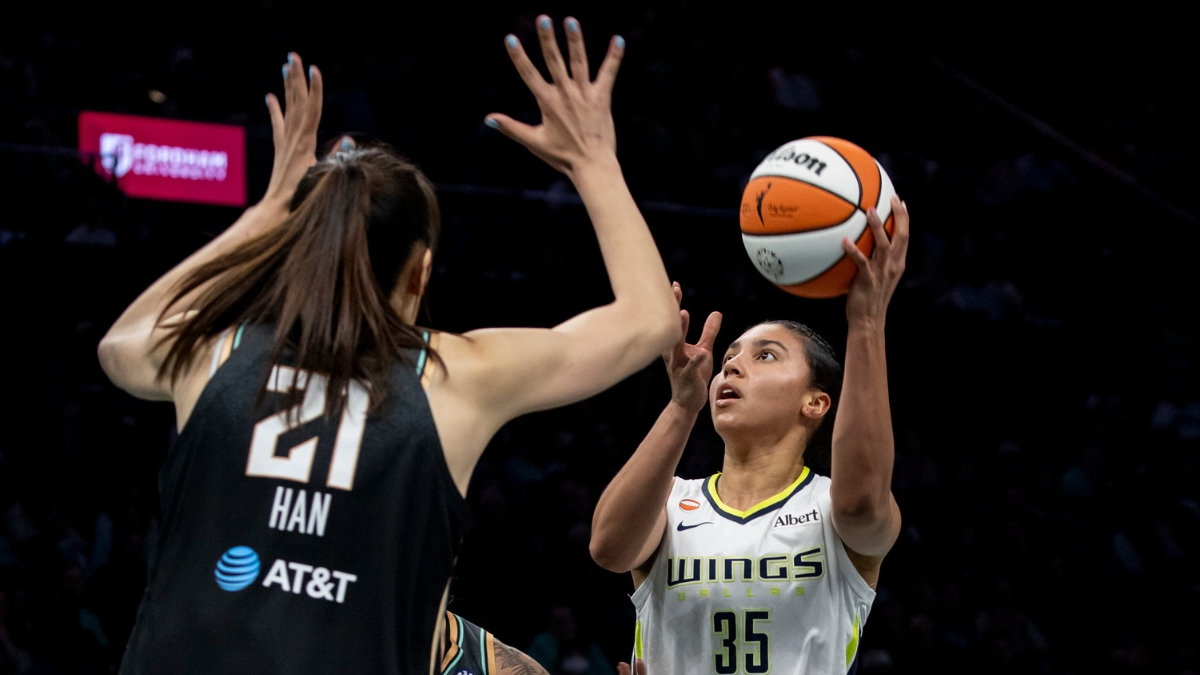
DHJ Quick Take: Fudd’s Record-Setting Surge and Defensive Adjustment Fuel Wings’ Statement Win
- The Ultimate Draft Validation: No. 1 overall pick Azzi Fudd exploded for 24 points on 9-of-15 shooting off the bench, setting a WNBA rookie record with six 3-pointers. The breakout performance prompted head coach Jose Fernandez to deliver the quote of the night: “I think now everyone knows why we took her number one.”
- Slowing Down the Pacing: After facing aggressive, over-the-top coverages early in the year, Fudd adjusted by deliberately slowing down her footwork and screen-reading. The change in tempo paid dividends in a team-high plus-22 performance, forcing an in-game adjustment that saw her start the second half.
- The Halftime Defensive Mandate: Trailing 44-43 at the half, Fernandez challenged the roster to take individual assignments personally. Dallas responded by throttling the 2024 champion Liberty to just 32 second-half points, utilizing Fudd as the primary on-ball defender to hold Sabrina Ionescu scoreless for the final 25 minutes of action.
- Solving the Under-Sized Tension: Despite legitimate pregame questions regarding the defensive viability of an undersized three-guard lineup featuring Fudd, Paige Bueckers (24 points), and Arike Ogunbowale (19 points), the Wings secured a 34-34 rebounding tie against New York’s frontcourt size, anchored by Jessica Shepard’s near triple-double (10 points, 11 rebounds, 6 assists).
BROOKLYN — The pregame conversation centered on what the Dallas Wings could learn about themselves on the final leg of a three-game road trip. The answer arrived in the form of a rookie record, a lockdown defensive half, and the clearest sign yet that the franchise’s bet on Azzi Fudd with the No. 1 overall pick in the 2026 WNBA Draft is paying off in real time.
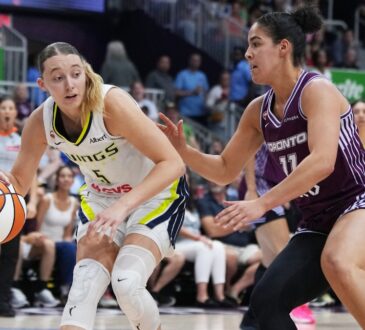
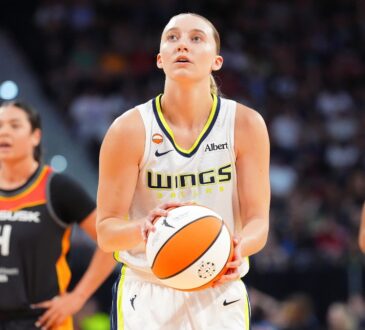
Fudd scored 24 points on 9-of-15 shooting and connected on 6-of-12 from three in 32 minutes off the bench, setting a WNBA rookie record for made 3-pointers in a single game, as the Wings beat the New York Liberty 91-76 on Sunday afternoon at Barclays Center. Dallas improved to 4-3 on the season with its second win in three games, closing the road trip 2-1 after wins in Washington and Chicago and a loss in Atlanta.
Paige Bueckers matched Fudd’s 24 points on 7-of-13 shooting and 8-of-8 from the free-throw line, added 6 rebounds, and defended Breanna Stewart and Sabrina Ionescu on switches in the second half. Arike Ogunbowale chipped in 19 points, 4 rebounds, and 5 assists. Jessica Shepard stuffed the box score with 10 points, 11 rebounds, and 6 assists on 5-of-9 shooting, leading the Wings to a 34-34 rebounding split against New York’s frontcourt size. Awak Kuier added 10 points, 6 rebounds, 1 assist, and 2 blocks on 2-of-3 shooting from three in 24 minutes off the bench.
The trio of Ogunbowale, Bueckers, and Fudd combined for 67 points — a number head coach Jose Fernandez had hinted at when discussing his three-guard lineup’s offensive ceiling during pregame availability.
“When they’re all three on the floor together, the numbers don’t lie,” Fernandez said pregame.
The numbers didn’t lie on Sunday. The trade-off Fernandez had been navigating through the season’s first seven games — perimeter scoring firepower versus interior size — broke decisively in Dallas’ favor against a Liberty team that came in with significant frontcourt advantages on paper.
Azzi Fudd Delivers Historic Breakout
Fudd’s performance arrived in the exact context Fernandez had previewed pregame. Defenses across the league have spent the season’s opening weeks blanketing her off the ball, forcing her into uncomfortable on-the-move catches, and daring her to put the ball on the floor rather than catch and shoot. Fernandez was asked before tip-off what indicators he had seen that Fudd was adjusting to those coverages — and his answer doubled as a preview of what would unfold Sunday night.
“Game by game, I think that you’ve seen how comfortable she’s getting, both on the offensive side and the defensive side of the ball. Teams are doing a really, really good job on her defensively. They’re not lateral helping off of her. Any flare screens are going over the top,” Fernandez said pregame. “But the thing that I’ve been most impressed with is she gives us such a big lift when we go to her off the bench because she can shoot it, she can space the floor, she can create off the bounce. And defensively, that’s something that she’s gotten so much better at.”
Fudd was a plus-22 in the win and started the second half after coming off the bench in the first. Asked what unlocked her rhythm in the third quarter — when she set the rookie record — Fudd attributed the shift to a deliberate change in tempo rather than any tactical adjustment.
“My goal today was just to play a little bit slower. I felt like I was rushing a little bit every time I caught the ball. I wasn’t reading right away. I was just putting the ball down, going too fast,” Fudd said. “So my goal was just to slow down, and my teammates were setting great screens, giving me great passes. Reading what was there was the key tonight.”
The performance was the kind of national-stage moment that turned the Wings’ long-held conviction into a tangible on-court reality. Fernandez’s postgame response on what the breakout said about Fudd’s WNBA ceiling captured the certainty the organization has carried since draft night.
“I think now everyone knows why we took her number one,” Fernandez said.
The Wings head coach had addressed the same external debate in pregame remarks, framing the selection through a roster-construction lens rather than a head-to-head prospect evaluation.
“For our franchise, and we’ve said it and we have never wavered, Azzi was the number one pick and was the best fit for our team and our style of play and the way that we wanted to play. That answer hasn’t changed from when we drafted Azzi and where we’re at seven games now. A lot of people don’t know what’s in the locker room or what goes on in practice,” Fernandez said pregame. “But we needed to address some of the three-point shooting. We needed another high-caliber guard that was gonna be able to space the floor and shoot the three, and that was Azzi.”
Returning to Barclays Center for the first time in the WNBA carried its own significance for Fudd, who scored 27 points in the building for UConn against Iowa in December. Asked whether the prior experience helped her settle in, Fudd pointed to crowd energy rather than familiarity with the floor.
“I mean, not that it feels like a home game, but having the experience of playing here before was really nice because this was a lot of fun. The atmosphere is incredible from when I was here with UConn, even more so tonight,” Fudd said. “Having that experience with the crowd — it gets super loud. Honestly, it was distracting. I wanted to dance because the crowd was going. I was locked in in the huddle, but it’s definitely a really fun crowd.”
The pressure on Fudd as the No. 1 pick has been a constant subplot through the Wings’ early-season coverage cycle. Ogunbowale, who has navigated her own version of national scrutiny across seven seasons in Dallas, framed the breakout within the broader arc of a rookie season that is still only seven games old.
“I think it just shows what she’s capable of. Obviously the world’s putting pressure on her, but it’s day by day. She’s still a rookie. She’s still learning. It’s literally only game seven, and she’s coming into her own,” Ogunbowale said. “But we need her to be aggressive like this — shoot the ball whenever she’s open — and she did that today, so it was good to see.”
Bueckers, who played alongside Fudd at UConn and knows her shooting habits better than anyone in the Wings locker room, framed the night as a matter of timing rather than surprise.
“Same thing that Arike’s saying, but we knew she had this in her. We knew it was only a matter of time. It takes time as a rookie to get your legs under you, your feet going, and just get some experience and reps at it,” Bueckers said. “So it was only a matter of time before we knew the breakout was coming. For us as teammates to instill that we need her, and we know she’s more than capable of doing stuff like this on any given night, I think that’s just what the future looks like.”
Fudd’s impact extended beyond the box score on the defensive end. Ionescu did not score after the 5:11 mark of the second quarter and finished 4-of-15 from the floor. Fernandez credited a halftime adjustment that put Fudd in primary on-ball defensive assignments against the Liberty star.
“We talked about at halftime that we needed to put more pressure on her. If she brought it up the floor, trying to wear her down. I thought Azzi did a great job not only on the offensive end, but also on the defensive end on her,” Fernandez said.
Fudd’s defensive impact has been a recurring talking point from Fernandez through the season’s first seven games, and he expanded on what makes her instincts on that end translate so quickly to the pro level.
“Her hands are active. She does a good job pressing up. Sometimes she presses up too much above the 28-foot line where she can get in trouble and the ball goes by her, but her hands are so active in terms of deflections,” Fernandez said. “You can tell she has such great instincts that you just can’t teach in regards to switching and X-ing out on the backside. If she’s stuck on a big, she’s not going to sit behind. She’s going to work to the front and make someone make a tough pass over the top.”
The 32 minutes Fudd logged Sunday were a season high and continued a steady upward trajectory in her workload. Asked whether the performance accelerated his timeline for moving Fudd into the starting lineup, Fernandez signaled the direction is already in motion.
“How many minutes did she play tonight? Thirty-two? Her minutes have increased game by game. I think it’s been a conversation. I think we’re headed that direction. I think it showed with her being on the floor and what she did. She started in the second half,” Fernandez said.
Defensive Identity Crystallizes in the Second Half
Both teams scored at a high rate through the first 20 minutes. New York led 44-43 at halftime after the Liberty went 12-of-29 from the floor in the first half. The shift came at the break, when Fernandez challenged his group to take the defensive end personally — framing the game’s outcome as a binary choice between two evenly matched offenses.
“I told them at halftime the team that was going to win this game — both very good offensive teams — was going to be the team that took it personal and the team that was going to do a much better job on the defensive end. Both teams can score. Both teams move the ball very, very well. They can score inside, they can score off the bounce, both teams can stretch the floor from three,” Fernandez said. “It was going to come down to the defensive end. Who was going to decide to defend? The team that decided to defend and continue to score on the other end was going to be the team that won. That was us.”
The Wings held the Liberty to just 32 points after halftime — 17 in the third quarter and 15 in the fourth — while scoring 48 of their own. Dallas finished the game shooting 46.2% from the floor and 42.9% from three (15-of-35), while holding New York to 38.9% shooting and 30.8% from three (8-of-26).
Bueckers was asked postgame whether the second-half performance represented the blueprint for how the Wings need to play to win in the league — a question that prompted her clearest articulation of the team’s identity to date.
“Every night looks different. Every night in the W, you try to win and be able to play different ways. But for us to have a set identity and a set foundation for what we want to look like on any given night, that’s to control the controllables — whether it’s our energy, effort, our attitude, how selfless we play, how we play together, and how we talk and communicate,” Bueckers said. “Those are all things we want to control, and we want the foundation to be that. I feel like we did a lot of that tonight. We played really connected, really together on both sides of the floor. So the controllables are what we want to continue every night.”
The defensive sustainability of the three-guard lineup featuring Ogunbowale, Bueckers, and Fudd had been the central tension in pregame coverage. The trio has thrived offensively across early-season minutes but had faced legitimate questions about whether it could hold up defensively against teams with significant size advantages — exactly the matchup the Liberty’s frontcourt of Stewart, Jonquel Jones, and Satou Sabally presented. Fernandez addressed the trade-off directly when asked pregame whether the smaller closing group could become a reliable unit.
“That was a concern — how are you gonna play Paige, Arike and Azzi together? How are you gonna get stops, and how are you gonna rebound?” Fernandez said pregame. “But the same thing, we’re tough to guard on the other end as well. With some big lineups, we’ll probably have to look at Maddy at the three or Awak at the three, but it’s still really, really early in the year.”
Ogunbowale, asked pregame about the defensive trade-offs of the three-guard look, leaned into the group’s collective accountability rather than dismissing the size concerns.
“I think we just focus on what we have. I understand with the size, but I think we can score with the best. We can guard the best when we’re locked in and we don’t really focus on that height difference. We just go out there and ball,” Ogunbowale said pregame. “Like you said, defense, it may be a struggle, but they also have to guard us too. So hopefully we don’t trade baskets. We have to play more team defense when it’s us three since we are a little bit undersized. But when we play like a group, help the helper, I think we’ll be okay.”
Bueckers, asked the same question pregame, struck a similar tone.
“Yeah, I think we might not be as tall, but I think we’re very strong and we’re very willing to be able to switch and guard and compete that way,” Bueckers said pregame.
Sunday’s result was the proof of concept. Dallas finished even on the boards (34-34) against a Liberty team that came in with the size advantage on every line of the matchup chart.
Jessica Shepard’s Glue Work and the Frontcourt Rotation
Shepard’s near triple-double anchored the Wings’ frontcourt effort. The 6-foot-4 forward has emerged as the connective tissue for an offense that asks both Bueckers and Ogunbowale to play off the ball at times — a structural feature that the entire Wings core spent pregame availability emphasizing.
Asked pregame about the four-player lineup featuring her alongside Ogunbowale, Fudd, and Bueckers, Shepard pointed to the prior chemistry connections that have helped the group accelerate its on-court timing.
“For sure it plays a part. Obviously we have a lot of scorers on this team, a lot of people who can put the ball in the hoop at any time. So I think those three guards — obviously Azzi and Paige have played together before, so they kind of know where each other’s gonna be on the court. And then obviously I’ve played with Arike before, so that’s an easy connection for me,” Shepard said pregame.
Fernandez detailed pregame how Shepard’s positioning on defensive rebounds creates an unusual transition-offense wrinkle for the Wings, one that takes the ball out of the point guards’ hands earlier than typical possessions.
“The good thing is with Jess, because of the way that we play, we only time the outlet to our point guards after a made basket. So she gets it off the glass, now she starts a break,” Fernandez said pregame. “That’s why she’s able to pass and get into some DHOs and reversals and get downhill so we can set some inverted ball screens for her as well.”
Ogunbowale, who played alongside Shepard at Notre Dame under Muffet McGraw, was asked postgame what Shepard brings to the team. She framed Shepard’s value through both their shared history and the broader fit on the current Wings roster.
“I think Jess is one of the most versatile posts in the game. She had to play behind Phee, who’s obviously one of the best, but when [Napheesa Collier] was hurt, Jess was really doing her thing and helping lead Minnesota,” Ogunbowale said. “Having her here is super special. She can initiate the offense, has a great basketball IQ, can find the open man, rebounds, hustles — she just does all the little things. I think she’s really a glue piece for this team that helps everything come together with the guards and the posts. She’s really tough. She works hard on her game, on her body, on her physicality, and she’s going to be really good for us throughout this year.”
Kuier’s emergence as a second-half option provided Fernandez with a frontcourt lineup that could stretch the floor while still protecting the basket. She played 24 minutes — significantly more than starter Alanna Smith, who logged 14:39 — and finished with 10 points, 6 rebounds, and 2 blocks. Asked specifically about Kuier taking over for Smith in the second half, Fernandez pushed back on the framing of the rotation change.
“I don’t look at it as anyone getting benched. I don’t like to use that word. Rotationally and matchup-wise, we just felt on the offensive and defensive end that her being in the game would give us the best opportunity for success,” Fernandez said.
The Wings head coach also explained how Kuier’s two-way profile fits a versatile frontcourt rotation that gives Fernandez multiple lineup options depending on opponent.
“Look at now Awak with time and her being so comfortable. She can stretch the floor because she can shoot the three, but also protect the basket. Anything post-to-post, she can switch with Jess,” Fernandez said. “It’s a good problem to have when you have Jess, Alanna, Maddy, Awak — on any given night, depending on what our needs are and who we’re playing, any one of them can play and help us.”
Paige Bueckers Continues Expanding Her Game
Bueckers played 36:21 — the most minutes of any Wings player — and continued to flash the off-the-dribble creation that has defined her second-season leap. Defenses across the league have been throwing increasingly aggressive coverages at her, a pattern Fernandez detailed pregame in clinical detail.
“When she’s off the ball, she’s getting topside a lot. She’s getting full denial, then she’s getting blown up off of handoffs. Pick-and-roll situations, she’s getting trapped,” Fernandez said pregame. “So I think the more that we can run her off different screens and misdirections to try and get her in some space. But then when the ball’s in her hands and she’s at the point guard spot, once she gives it up, teams are making it very difficult for her to get it back. Off of any DHO, they blow it up, or any ball screen action, they trap her to get it out of her hands. So we just gotta do a good job getting the ball where it needs to get to and making the right passes.”
Bueckers was asked postgame what has been key in her development as someone who creates off the dribble so well. She pointed to offseason film study as the foundation for the polish she has shown through the season’s first seven games.
“Just a lot of offseason work and a lot of watching film — constantly watching basketball, whether it’s the NBA, WNBA, or college basketball. Just picking stuff up and trying to implement it into my game,” Bueckers said. “And then having teammates and a coaching staff that instill that confidence within me to go attack, be aggressive, and put up my shot. Having great spacing and great players on the floor makes that opportunity available.”
Sunday’s matchup also held personal significance for Bueckers, who has long cited Stewart as a model for her career trajectory. Bueckers shares an athletic trainer, strength and conditioning coach, and life coach with the Liberty star — and was asked pregame what Stewart has meant to her.
“She’s the ultimate winner, ultimate competitor. She’s everything that I wanted to be growing up. Wanting to go to UConn, fill in her shoes,” Bueckers said pregame. “Everybody who goes to college aspires to have a Breanna Stewart career and to win four championships and to be a winner at every single level. And to be behind the scenes to see how hard she works, we have the same athletic trainer and strength and conditioning coach and life coach, Susan King Borchardt. So to have that accessibility to her, to be able to talk, to have her as a mentor, it means a lot.”
Sunday also featured fewer half-court initiation reps for Bueckers than in previous Wings games, with Shepard and others bringing the ball up at times. Asked whether the change in role affected her offensive flow, Bueckers said she’s embracing the positional flexibility.
“I think it depends on who’s out there — whether we have another point guard like [Odyssey] out there. Sometimes Jess brings it up, or one of these guys brings it up,” Bueckers said. “I think it’s just learning how to play within the flow of the offense, whether I’m initiating or not initiating, and having different sets to go to on ball and off ball. That’s something we’re still learning and growing at. So no, I think everything worked out perfectly.”
New York Liberty’s Effort and Injury Context
Stewart led the Liberty with 14 points and 11 rebounds on 7-of-18 shooting. Sabally added 20 points on 6-of-14 shooting and 5-of-5 from the free-throw line. Jones posted 14 points and 7 rebounds, and Ionescu finished with 11 points, 5 rebounds, and 7 assists. The Liberty were without Marine Fauthoux (left knee rehab), Leonie Fiebich (rest), and Betnijah Laney-Hamilton (personal).
New York fell to 3-3 on the season and was outscored by 15 points despite shooting 85.7% from the free-throw line. The Wings forced 9 turnovers and held a 17-10 advantage in fast-break points. The Liberty’s 40 points in the paint were not enough to offset Dallas’ 15 made 3-pointers.
The Wings return home Tuesday to host the Las Vegas Aces at College Park Center.
More Wings Coverage on Dallas Hoops Journal
- ‘Felt Like She Had 25’: Awak Kuier Shows Dynamic Potential For Dallas Wings Amid Career-High vs. Atlanta Dream
- ‘Ready For Every Second’: How Li Yueru’s Positive Mindset Bolsters Dallas Wings’ Center Depth
- ‘Short-Term Memory’: Dallas Wings Fall 86-69 To Atlanta Dream As Rhyne Howard Drops 25 In Fourth-Quarter Pull-Away
- ‘You Have To Own The Glass’: How Dallas Wings Plan To Rewrite The Script In Atlanta Dream Rematch
- ‘Taking What The Defense Gave Me’: How Jessica Shepard’s Triple-Double Unlocked The Dallas Wings In Chicago
- Arike Ogunbowale Reaches Historic WNBA Milestone In Dallas Wings’ Win Over Chicago Sky
- ‘Li Changed The Game Defensively’: How Li Yueru Powered A Dallas Wings Turning Point In Chicago
- ‘Controlling The Controllables’: Jessica Shepard Reflects On Dominant Double-Double For Dallas Wings vs. Washington Mystics