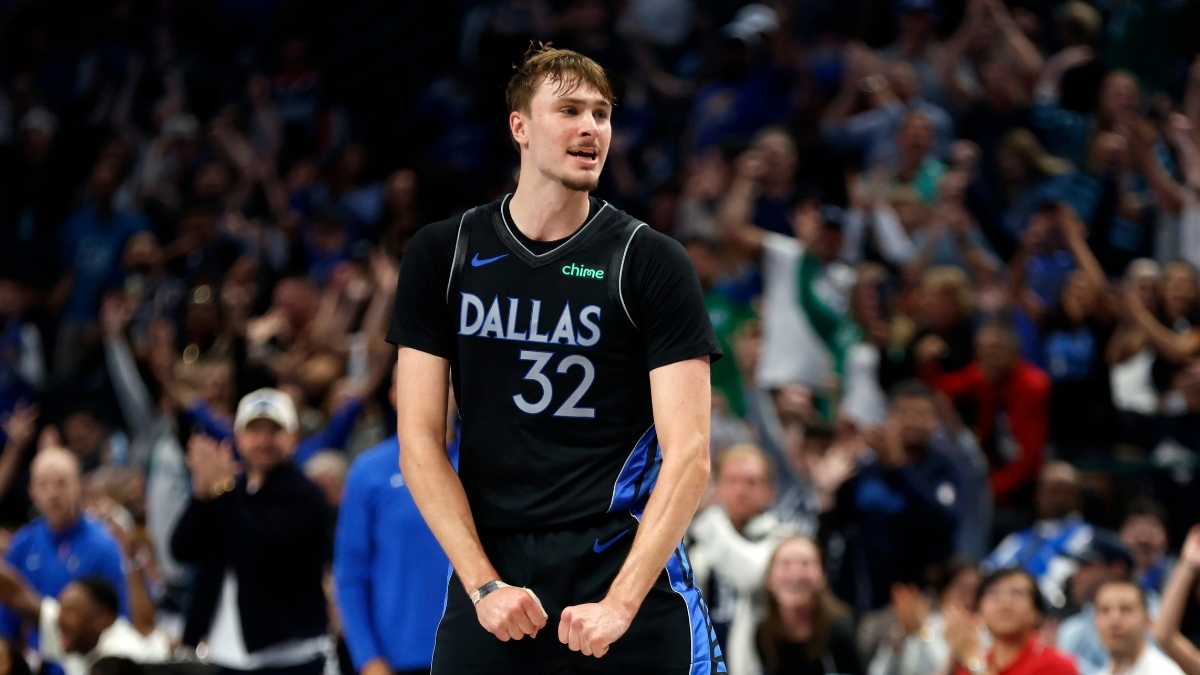
Few rookies enter the NBA with as many expectations as Cooper Flagg’s. Drafted as both a present contributor and long-term cornerstone, Flagg arrived at the professional level with a rare combination of defensive instincts, positional versatility, and competitive edge that translated right away. At the same time, the move from elite amateur basketball to the physicality, pace, and tactical complexity of the NBA has challenged every aspect of his game.
Through 38 games this season, Flagg has averaged 18.9 points, 6.4 rebounds, and 4.2 assists, production that reflects both his expanding responsibility and the variability that often accompanies a broad developmental role. He’s currently the leading candidate for the NBA’s Rookie of the Year award as Dallas navigates a tough season strongly impacted by injuries.
His rookie season is best seen, however, not as a linear upward trajectory, but as a development curve characterized by adjustment, resilience and glimpses of true stardom – one whose arc resembles the manner in which organizations value long-term upside with different paths to success – in much the same way as considering options for VA players as they project future value beyond immediate output.
Adapting to the Immediate NBA Physicality
One of the most visible obstacles Flagg has had to overcome as a rookie is the physical cost of the NBA schedule. At the collegiate and international youth levels, his length, timing, and motor enabled him to dominate defensively without constantly absorbing contact from fully developed professionals. In the NBA, stronger wings and forwards have gone to him early on, leaving him to defend through contact and complete plays on bodies rather than with space.
This adjustment has manifested itself most significantly on offense. Flagg’s efficiency has been in flux as he learns which looks will work against elite defenders and which ones require extra strength or counters. These struggles are not uncommon for young forwards, especially those whose games are based on versatility rather than one outstanding scoring weapon. The good news is that his confidence has not faltered; he continues to undertake hard assignments and aggressive scoring attempts, signalling confidence in the development process.
Defensive Impact That Is Translated Immediately
While offensive consistency is still in the making, the value of Flagg’s defense has translated more quickly. His ability to read passing lanes, rotate as a weak-side rim protector, and switch between multiple positions has made him impactful on nights when his scoring is dipping. Coaches like rookies who don’t get picked on defensively when they stay on the floor, and Flagg has passed most of that.
What differentiates him from so many young defenders is the anticipation. Rather than reacting late, he often pinpoints actions before they have fully developed. This has enabled him to create deflections, challenge shots without fouling, and interrupt offensive tempo.
These characteristics all point towards a defensive ceiling that transcends solid starter level and into elite two-way potential if refinement is allowed to continue.
Offensive Growing Pains and Skill Expansion
Offensively, Flagg’s rookie season has been a study in experimentation. He has been asked to handle the ball, operate as a cutter, space the floor, and occasionally initiate offense against set defenses. This has been a broad usage, which has shown the gaps in his handle and shot creation – especially against defenders who are allowed to stay in front of him laterally.
However, these are growing pains that are strategically valuable. Rather than trying to keep him in a small role, the coaching staff seems determined to stress-test his skill set. His willingness to attack on closeouts, make secondary reads, and attempt pull-up jumpers indicates that he understands that, in the long term, development often requires short-term inefficiency. As his shooting mechanics become more stable and his decision-making becomes faster, these reps should translate into better, more consistent scoring.
Mental Resilience and Professional Maturity
One of the most promising aspects of Flagg’s rookie year has been his mindset. He has had some off-stretches, decreased usage in certain matchups, and increased scrutiny, but he has kept his energy level and involvement on defense pretty even. For a rookie, this is an important determinant of sustainable growth.
Flagg’s body language speaks to a player who is process-oriented rather than outcome-oriented and concerned with immediate validation. He competes on every possession, takes coaching, and changes his role to meet the team’s needs. This level of professionalism speeds up development because learning is allowed to compound rather than reset with setbacks.
The Breakout Indicators from Below the Surface
While it may not always be reflected in box score production, there are several indicators pointing to breakout potential. His defensive impact is enhanced when he plays with structured lineups, suggesting that his value increases with team cohesion. His off-ball movement has improved throughout the season, creating easier scoring opportunities that are not reliant on isolation.
Just as important, his presence in late-game defensive possessions is becoming more consistent. Trust from coaches in high-leverage moments often precedes expanded offensive responsibility, and Flagg seems to be winning that trust on an incremental basis.
Projecting the Next Stage of Development
Looking forward, Flagg’s breakout is more likely to come about through cumulative refinement than a single leap. Added strength will mean better finishing and more versatile defensive impact. Incremental shooting improvement will force tighter closeouts and open driving lanes. Improved ball security will lead to fewer turnovers and open self-created offense.
If these things develop together, Flagg sees a two-way forward that can anchor high-level defensive units while making efficient contributions on offense. His challenges in his rookie season are providing the structural framework for that evolution.
A Rookie Season that Indicates Long-Term Upside
Cooper Flagg’s first year must be judged less in terms of peaks and valleys and more along lines. The challenges he has faced are typical of a player who has been asked to grow in real time against the world’s best competition. The flashes he has shown, especially on defense and in high-effort situations, are suggestive of a player whose impact only deepens as his skills catch up to his instincts.
If development continues on its current path, Flagg’s rookie season could end up being remembered not for inconsistency but as the proving ground for a future breakout cornerstone.