DHJ Quick Take: Navigating the Mavs’ Generational Gap
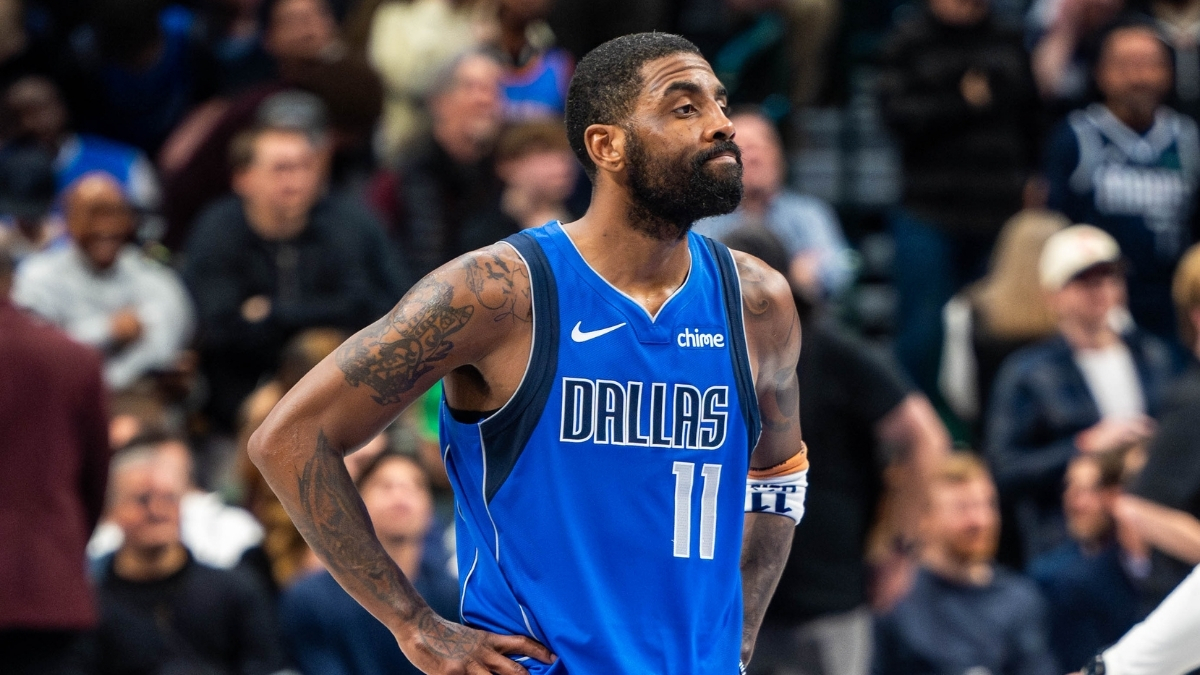
- The 15-Year Contradiction: The Dallas Mavericks enter the 2026 offseason occupying a distinct, non-traditional developmental timeline. The franchise anchors its entire future on 19-year-old rookie sensation Cooper Flagg, yet its primary offensive partner remains 34-year-old veteran Kyrie Irving.
- The Valuation Dilemma: While conventional NBA team-building logic dictates flipping aging stars to match a rookie’s timeline, Irving’s depressed open-market trade value—compounded by a season-ending injury—makes an immediate trade highly imprudent. Trading him now represents a severe short-term talent downgrade with minimal long-term asset return.
- The On-Floor Symmetry: From a pure X’s and O’s perspective, Irving is the ultimate half-court release valve for Flagg’s current developmental stage. With Flagg connecting on just 29.5% of his 3-pointers as a rookie and still sharpening his half-court self-creation, Irving’s historic handle and elite shot-making relieve immense defensive pressure off the young forward.
- Skill Over Athleticism: Because Irving’s perimeter efficiency relies on supreme technical skill rather than raw vertical athleticism, his game is uniquely positioned to age gracefully over the next three to four seasons. This exact window perfectly intersects with Flagg’s projected ascent into All-NBA production.
- Preserving the Asset Horizon: Under the newly restructured front office led by President Masai Ujiri and General Manager Mike Schmitz, the Mavericks should confidently open the 2026-27 campaign with Irving in the starting lineup. Maintaining him on the roster preserves flexibility: Dallas can either showcase him to extract assets from a desperate contender at the trade deadline, or push their chips in for a third high-level option to contend immediately around the Flagg-Irving axis.
The Dallas Mavericks need to find a co-star for Cooper Flagg. They already have one. That contradiction defines the unusual position the franchise occupies. The Mavericks have their franchise player, and he is 19 years old. They have another star, and he is 34.
The conventional approach would be to move the older star. For Dallas, the choice is more complicated. The roster is light on future-focused assets, and Kyrie Irving, for all his talent, is an injury-prone player whose trade value is depressed. He may not return a significant haul on the open market. That reality raises a different question: why move him at all?
The Case for Keeping Kyrie Irving for Now
Irving is a logical fit alongside Flagg. Flagg is a playmaking forward with an unreliable jump shot, having connected on 29.5% of his 3-pointers as a rookie. His handle is functional enough to make him a threat in transition, but he can struggle to create his own scoring in the halfcourt.
A player in that mold benefits from a partner who is among the best ball-handlers in NBA history and one of the toughest shot-makers the game has produced. That description fits Irving.
Irving’s game was never built on elite athleticism. It is built on skill, and skill ages well. He should remain effective for another three or four seasons, a window in which Flagg is positioned to enter All-NBA discussions.
Why the Dallas Mavericks Could Entertain Trades Later
Irving’s value sits at a low point. A season-ending injury did not help his standing around the league. Trading him now would be a short-term downgrade with insufficient long-term return.
Dallas should open the 2026-27 season with Irving in the starting lineup. That does not rule out a move at the trade deadline. The right set of circumstances could make a deal prudent.
If Irving is playing at the level he has reached before, and the Mavericks are underperforming despite that, the calculus changes. A contender in need of point guard play that is willing to part with multiple future first-round picks would give Dallas a reason to act.
Flagg is the most important player on the roster, and the Mavericks must prioritize his timeline. That means eventually finding a co-star closer to his age. Until Dallas has the assets to make that move, holding Irving is the smarter course unless a strong offer arrives.
There is also a path in which the Mavericks trade everything else available for a third option and contend around that player, Flagg, and Irving sooner than expected.
For now, Flagg’s co-star is already in Dallas.
More Mavericks Coverage on Dallas Hoops Journal
- ‘Chaotic In A Beautiful Way’: Mike Schmitz Opens Up On Quick Rise To Dallas Mavericks GM Chair
- Dallas Mavericks To Select 9th Overall In 2026 NBA Draft, Mike Schmitz ‘Very Confident’ In Class Depth
- Dallas Mavericks Name Mike Schmitz General Manager Under President Masai Ujiri
- ‘I Hope To Bring Calm’: Masai Ujiri Lays Out Vision For Cooper Flagg’s Dallas Mavericks
- ‘It Means Everything’: Dallas Mavericks Star Cooper Flagg Reflects On NBA Rookie Of The Year Award
- Cooper Flagg Wins NBA Rookie Of The Year, Joins Jason Kidd And Luka Dončić In Dallas Mavericks History
- ‘That’s What Paul Silas Did For Me’: LeBron James Draws Parallel Between His Rookie Role And Cooper Flagg’s
- ‘He Will Be Unstoppable’: Cooper Flagg’s Three-Point Statement Gives Blueprint For NBA Dominance
- ‘They’re Very Similar’: Jason Kidd Breaks Down The LeBron James Parallels For Cooper Flagg