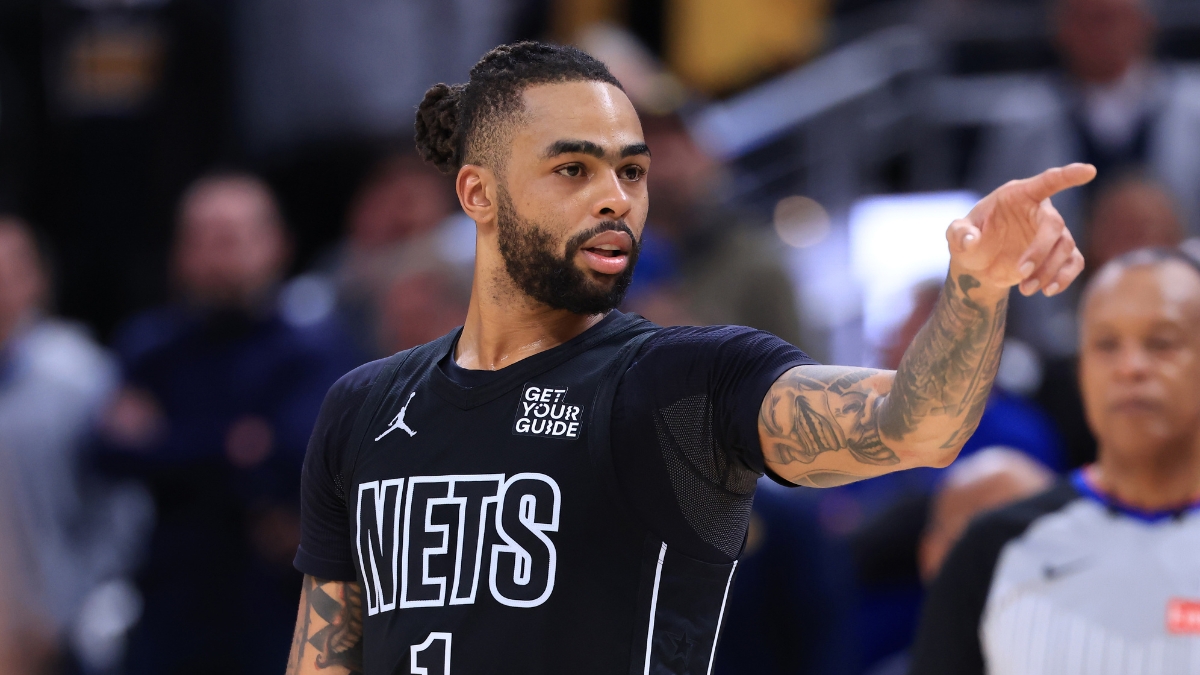
The Dallas Mavericks turned to D’Angelo Russell this summer as their lone free-agent addition, hoping his experience could steady the backcourt while Kyrie Irving recovers from ACL surgery. Russell, 29, is entering his 11th NBA season and signed a two-year, $12 million contract with a player option for next year.
His résumé includes All-Star recognition in 2019, a reputation as a crafty playmaker, and a career that has taken him from Los Angeles to Brooklyn, Golden State, Minnesota, and back to Los Angeles before his latest stop in Dallas. While last season was statistically his worst — averaging 12.6 points and 5.1 assists on 39% shooting — Russell insists he has found a renewed edge.
Mindset And Feeling In His Prime
On The Backyard Podcast, he offered candid reflections about his preparation, durability, competitiveness, and the evolution of his game.
Russell described his perspective heading into another year, emphasizing that he still sees himself at the height of his career despite past injuries and changes in role. He pointed to both his physical condition and his mental sharpness as proof.
“I feel like I’m in my prime. Like I don’t feel old. I feel stronger. I feel wiser,” Russell said. “That’s why I mess with Chris Paul so much ‘cause I watch him get fiery as hell when he about to lose. He gets so fiery. Like when I got around Book, I was just like, ‘Yeah, that’s my dog right there.’”
Adjusting Preparation And Protecting His Body
Reflecting on how his approach to the game has changed with age, Russell said that his preparation and recovery routines are far more deliberate now than when he first entered the league. Years of surgeries and physical wear, he explained, have forced him to be mindful of how he plays and how he recovers.
“Besides athleticism and stuff, I think the care, the care about your body is what changes,” Russell said. “Like back then you didn’t care. You would jump, you would land, you would fall, and the recovery would just be like right away. You’d be all right. And now after you get some surgeries, you get hurt a little bit… you’re just like, you know what? I care too much to like fall right there or hurt right there.”
That awareness, Russell said, has fundamentally changed the way he approaches live action. He explained that while his competitive drive hasn’t diminished, he now factors in the long-term cost of every collision or awkward landing, forcing him to balance effort with preservation each time he steps on the floor.
“You commit to playing hard. That’s one thing, but like the injury factor, you’re like more cautious now because that recovery time might be a little longer,” Russell said.
Russell went further, noting that the grind of the NBA schedule requires constant management, especially during stretches of back-to-back games. He described how his preparation between those contests has become almost ritualistic, with recovery routines and mental resets designed to keep his body steady across the demanding pace of the season.
“My preparation is completely different [for back-to-backs]. I know what I do after the first game of the back-to-back going into the second,” he said. “I feel like I’m in my prime. Like I don’t feel old. I feel stronger. I feel wiser. I feel more careful.”
Durability Versus Athleticism
Russell gave a blunt assessment of how his body responds today compared to his younger years. He said sprains and bumps linger longer, and the difference between durability and athleticism is more apparent with every season.
“I used to be able to roll my ankle… I know I’ll be all right. I just need a few weeks,” he said. “Now, if I roll my ankle, it don’t even swell up. It just like pinches my bone. Like my bone pinches. When you’re young and you roll, the ligaments are fresh. Now you’re older. Those ligaments are just kind of worn out. You’re not… your shakeback might be a little longer.”
Russell emphasized that simply being available game after game is not equivalent to possessing elite athleticism. In his view, durability is about withstanding the inevitable wear-and-tear of a long career, while athleticism is more about explosive movements that fade with age. He underscored that one can exist without the other, especially for veterans.
“I think durability and athleticism are totally different,” Russell said. “Durability can just be… you’re just calluses around you. You’re durable. When you talk about falling and getting hurt, that’s getting old and that’s not as durable.”
In comparing himself to his NBA peers, Russell was candid about where he fits in physically. He acknowledged that he has never been the type to overwhelm opponents with raw athletic gifts and that, by professional standards, his athletic profile is modest. Instead, he stressed that self-awareness has allowed him to carve out a role by leaning on skill, vision, and craft rather than pure explosiveness.
“I’m an average athlete in the pros. Below average. If I did combine testing… I would have dropped in the draft,” he said. “When you make it to the pros, you are allowed to find that lane of what makes you different than everybody else and also be honest with yourself… you aren’t the jumping over people like Ja Morant, but you can still find your way to make what you do a success.”
Lessons In Competition And Growth
Russell also spoke about how his competitive streak was forged at an early age. He recalled playing multiple games in a single day as a young player, and how his father instilled the importance of pushing through adversity.
“When I found basketball, I remember having like three games that day and after the first game, I’m crying. Boohooing. My dad’s like, ‘You crying for? You got another game in an hour.’ I’m like, ‘It hurts,’” Russell said. “I had to learn how to lose, bro. I used to try to cheat when I was losing. If I knew I was about to lose, I was like, I’m about to do something.”
Russell explained that his own intensity makes him gravitate toward players who display a similar fire. He said he respects competitors who treat losing as unacceptable and carry that urgency into every possession, and that being around players with that mindset pushes him to maintain his own edge. Conversely, he admitted it’s hard for him to connect with those who don’t show that same level of urgency.
“I gravitate to people that are like that [competitive], and then people that aren’t, you notice it and you kind of like teeter,” he said.
Russell said his game itself has gone through a similar process of refinement over the years. Early in his career, he leaned heavily on flash and creativity, often favoring no-look passes, behind-the-back feeds and highlight-driven plays. But as he gained more experience, he realized that flair alone wasn’t sustainable at the NBA level. The league’s pace, defensive schemes, and constant scouting, he explained, forced him to adjust, scale back the unnecessary risks, and build a more reliable foundation to his game.
“I was always way more flashy than anything. Like I used to be like Jason Williams—flashy, behind the back, bounce pass, no look, backboard,” he said. “If I would have saw what Steph was doing at that young, I would have been turn around, I would have been part of that trend… I was always just talented and flashy, and then I started realizing you can’t do that all the time, and that’s when I started to find my own little box. My whole career has been figuring it out, never played point guard until I got to the highest level…”
Fit With The Dallas Mavericks
Russell’s role in Dallas is shaped by timing. With Irving sidelined, he will be the primary guard option alongside Anthony Davis and Klay Thompson, both of whom joined the Mavericks via trade. His contract structure makes him both a valuable depth piece and a short-term risk, depending on how he performs.
For the Mavericks, Russell represents a veteran presence with the chance to prove his self-described prime years can still influence winning. For Russell, the challenge is straightforward: show that the wisdom and strength he says define him at 29 can translate into stability for a team in transition.
Latest Dallas Mavericks News & NBA Rumors
- NBA News: “Countdown Started”: God Shammgod Felt Luka Dončić Trade Triggered ‘Spooky Times’ for Dallas Mavericks
- NBA News: “Every Dollar We Raise Goes Right Back”: Dirk Nowitzki Hosts Star-Studded 7th Annual Tennis Classic in Dallas
- NBA News: “A Super Deep Team”: Dirk Nowitzki Confident in Dallas Mavericks’ Contender Status if Healthy
- NBA News: “The Owner Has to Show He’s Willing to Spend”: Dirk Nowitzki Advises Dallas Mavericks on Repairing Fan Trust
- NBA News: Dallas Mavericks Announce Overhauled Coaching Staff for 2025-26 Season
- NBA News: Sources: P.J. Washington, Dallas Mavericks Agree to Four-Year, $90 Million Extension
- NBA News: Dallas Mavericks’ Kyrie Irving Back on Court in New Video Over Five Months After ACL Surgery
- NBA News: Dallas Mavericks Announce Re-Signing of Danté Exum, Waive Olivier-Maxence Prosper
- NBA News: Dallas Mavericks’ Kyrie Irving is ‘Healing Up Great’ Five Months After ACL Surgery
- NBA News: Dereck Lively II Progressing Ahead of Dallas Mavericks Training Camp
- NBA News: “We Forget How Dominant He Can Be”: Former NBA Player Warns Not to Overlook Anthony Davis