DHJ Quick Take: Mavericks’ Guard Options at No. 9
The Dallas Mavericks hold the No. 9 pick in the 2026 NBA Draft and need a young guard to develop alongside Cooper Flagg. Brayden Burries, Kingston Flemings, and Mikel Brown Jr. each offer a different profile at that spot.
- Why does Dallas need a guard at nine? Kyrie Irving is 34 and the depth behind him is thin, making a developmental guard the logical fit next to Cooper Flagg.
- What does Brayden Burries offer? A physical, two-way combo guard who finishes through contact, shot 39.1% from three, and can switch across positions.
- Where does Kingston Flemings fit? A quick-twitch athlete and disruptive defender who slid down boards but profiles as a potential steal if he reaches nine.
- What is the case for Mikel Brown Jr.? The highest ceiling of the group, a scoring guard whose stock hinges on his health and consistency.
DALLAS — The Dallas Mavericks hold the ninth, 30th and 48th picks in the upcoming 2026 NBA Draft.
With the ninth selection, Dallas has the responsibility of finding a young player to develop alongside reigning Rookie of the Year Cooper Flagg. The Mavericks will have plenty of options, with this year’s class considered especially talented.
Dallas is reportedly open to moving up or down in the draft for the right price, according to Jake Fischer of The Stein Line. For the sake of this exercise, though, let’s assume that the Mavericks stand pat with the ninth pick.
A guard seems like the most likely selection for Dallas, with 34-year-old Kyrie Irving probably not on the same timeline as Flagg. Rumors have circled about Irving’s availability on the trade market, but the Mavericks reportedly don’t plan to move the veteran floor general.
Irving’s mentorship of Flagg is a key reason why the Dallas brass wants to keep him around, so it would make sense to bring in a guard for Irving to take under his wing as he nears the twilight stage of his career.
Further, the Mavericks’ guard depth is thin behind Irving. Undrafted rookie Ryan Nembhard showed promise last season, but it’s hard to project him as a future lead guard on a contending team.
So, who should Dallas key in with its lottery pick?
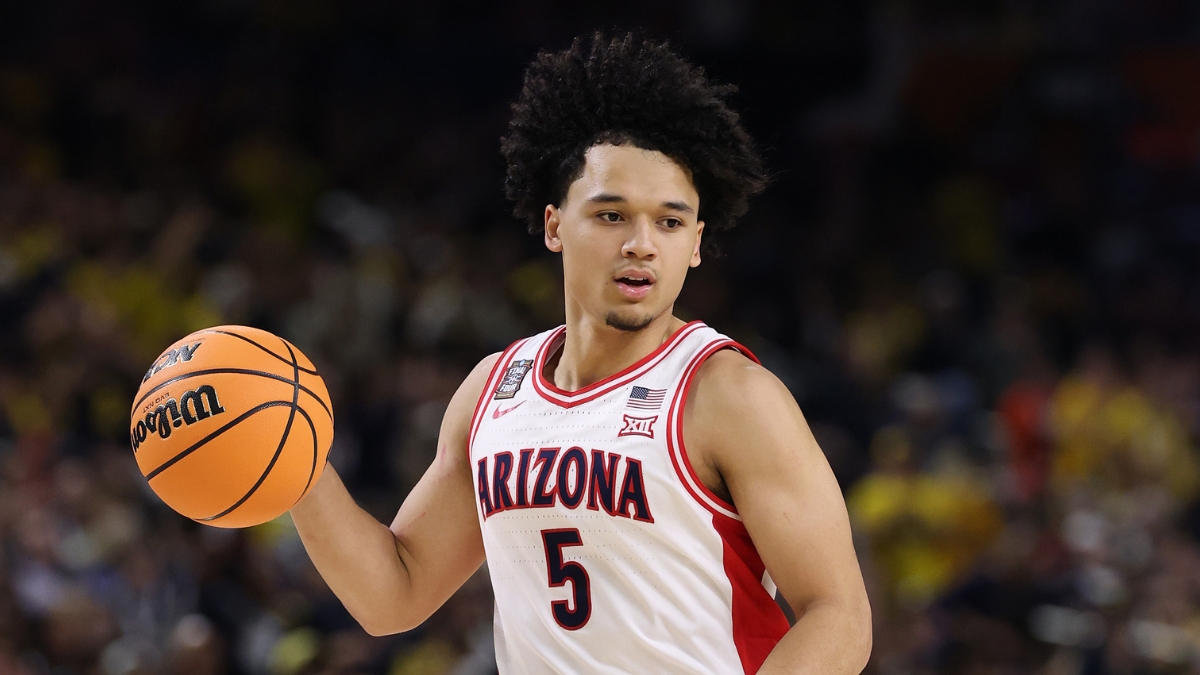
Brayden Burries, Arizona
Brayden Burries isn’t the flashiest selection, but he might be the safest.
As a freshman, Burries was the leading scorer for an Arizona team that made it to the Final Four. He thrived finishing around the rim, using his strength and creativity to power through defenders and finish from tough angles.
Burries isn’t an above-the-rim athlete, so his ability to get to his spots using fundamentals and footwork was essential for him and the Wildcats last season. He might not be a high-flyer, but he does possess a floater that he can employ to shoot over NBA-sized defenses.
As a shooter, Burries excelled at hitting off-the-catch triples with his pretty jumpshot. His ceiling as a shooter off the dribble and his deep-range ability remain to be seen, but he shot 39.1% from three and 80.5% from the free-throw line in college, suggesting growth in that department.
Although talented with his handle and capable of getting to his spots, Burries’ handle isn’t necessarily that of a primary creator. He isn’t one to blow by defenders or break down his man with an array of moves. Despite this, he seems to be aware of his limitations and is quick to make the right pass as a connective playmaker.
He’s no Magic Johnson, but Burries will make the right play more often than not.
Defensively, he shows a lot of promise. Burries is strong and physical, using that strength to wear down opposing guards over the course of a game. He knows when and how to switch onto larger players and shows a cerebral ability to read and jump passing lanes.
Kingston Flemings, Houston
Kingston Flemings seems to have fallen by the wayside over the past couple of weeks.
Early in last season, Flemings was seen as a potential top-five talent. Since then, he struggled against the best competition as Houston’s season wore on. With his struggles, players like Darius Acuff Jr. and Keaton Wagler jumped him across NBA big boards.
Now, it seems that Flemings might still be on the board at nine.
Unlike Burries, Flemings possesses quick-twitch athleticism that allows him to blow by defenders and dunk. His at-rim finishing numbers weren’t spectacular, but that could be in part due to the system he played in at Houston. He wasn’t surrounded by many shooters, so the spacing around him was minimal at times. That won’t be nearly as big a problem in the NBA.
Flemings was also surgical as a mid-range scorer. He uses a variety of moves to create space and knock down jumpers efficiently. Some scouts do point to an over-reliance on mid-range jump shots, suggesting that he needs a more balanced diet of three-pointers and rim pressure as well.
That might be true, but Flemings’ numbers as a three-point shooter show promise, albeit on a small sample size. He shot 38.7% on 2.9 triples attempted per game and 84.5% from the charity stripe.
He is also a more-than-capable playmaker, able to make good reads quickly and hit teammates with pinpoint passes. That said, his true calling card is his tenacity. Flemings was a pest on and off the ball, making life miserable for opposing guards. That ferociousness will be a real asset in the NBA, where Flemings will frequently be matching up with high-level guards.
Mikel Brown Jr., Louisville
Mikel Brown Jr. has the highest ceiling of the Mavericks’ options at nine.
He has been steadily climbing draft boards as concerns around the back injury that limited his time at Louisville have eased. Still, there’s a chance that he’s available when Dallas’ pick rolls around. That’s in part due to his injury history and in part to his inconsistencies as a player.
Sometimes, Brown looks like a guy who could average over 25 points in the league. That was certainly evident when he lit up NC State for 45 points and 10 three-pointers this February. But when the shot isn’t falling, it sometimes looks like he might just be a microwave scorer off the bench.
His playmaking is effective, especially out of the pick-and-roll, but Brown’s decision-making can be erratic at times. This was showcased by his 4.7 assists to 3.1 turnovers.
Now, were Brown’s struggles with consistency due to the injury he was dealing with or a flaw in his game?
That’s the question that NBA front offices are trying to answer. We might have more clarity by draft night or we might not know until we see him in an NBA uniform.
Although Brown’s floor could be worrisome for some, his upside might be too much to ignore if he falls to the ninth pick.
More Mavericks Coverage on Dallas Hoops Journal
- Sources: Jama Mahlalela Among Dallas Mavericks Head Coaching Candidates
- Jalen Brunson’s NBA Finals Run Is A Painful Reminder For The Dallas Mavericks
- ‘I’m Getting There’: Dallas Mavericks Center Daniel Gafford Provides Update On Ankle Recovery
- Podcast: NBA Draft Analyst James Barlowe Details Mavericks’ Options To Build Around Cooper Flagg
- Dallas Mavericks 2026 NBA Draft: The Case For Trading Down With The Oklahoma City Thunder
- Dallas Mavericks Enter Option Agreements For Former Valley View Mall Site For New Arena
- Dallas Mavericks Star Kyrie Irving Says He’s ‘Close To Being Over At 100%’ In ACL Recovery
- Mike Schmitz Says Dallas Mavericks Are ‘Looking At Everything’ For Next Head Coach
- Mike Schmitz Sees Kyrie Irving ‘Completely Locked In’ Around Dallas Mavericks Facility
- Dallas Mavericks ‘Mutually Agree’ To Part Ways With Jason Kidd, Begin Search For Head Coach