DHJ Quick Take: The No. 1 Pick Presser
- The Basketball Focus: While the headline-grabbing question took a different turn, the substance of the presser answered roster logic. Curt Miller detailed an “eyes, ears, and numbers” evaluation that identified Azzi Fudd as the perfect fit for the Wings’ spacing needs, while Jose Fernandez emphasized her 15-practice window to integrate into a high-IQ backcourt.
- The Double Standard: The framing of the Fudd/Bueckers pairing as a “culture risk” ignores the 2025 precedent of DiJonai Carrington and NaLyssa Smith. By treating a 23-year-old rookie’s personal life as a franchise crisis—while offering a deferential register to billionaire owners like Patrick Dumont—local legacy media continues to allocate its critical energy based on power rather than principle.
- The PR Wall: Wings PR lead Pam Flenke provided the defensive highlight of the afternoon. By acknowledging the reporter’s instinct but firmly declining to litigate players’ personal lives at a professional introduction, the organization set a boundary that prioritizes the locker room over the “traffic ceiling.”
- The UConn Connection: Despite the noise, the basketball reality remains: the Wings have successfully paired a decorated college championship-winning former duo. Fudd’s arrival as the “missing piece” to space the floor for Paige Bueckers and Arike Ogunbowale improves a 2026 roster reconstruction designed to compete.
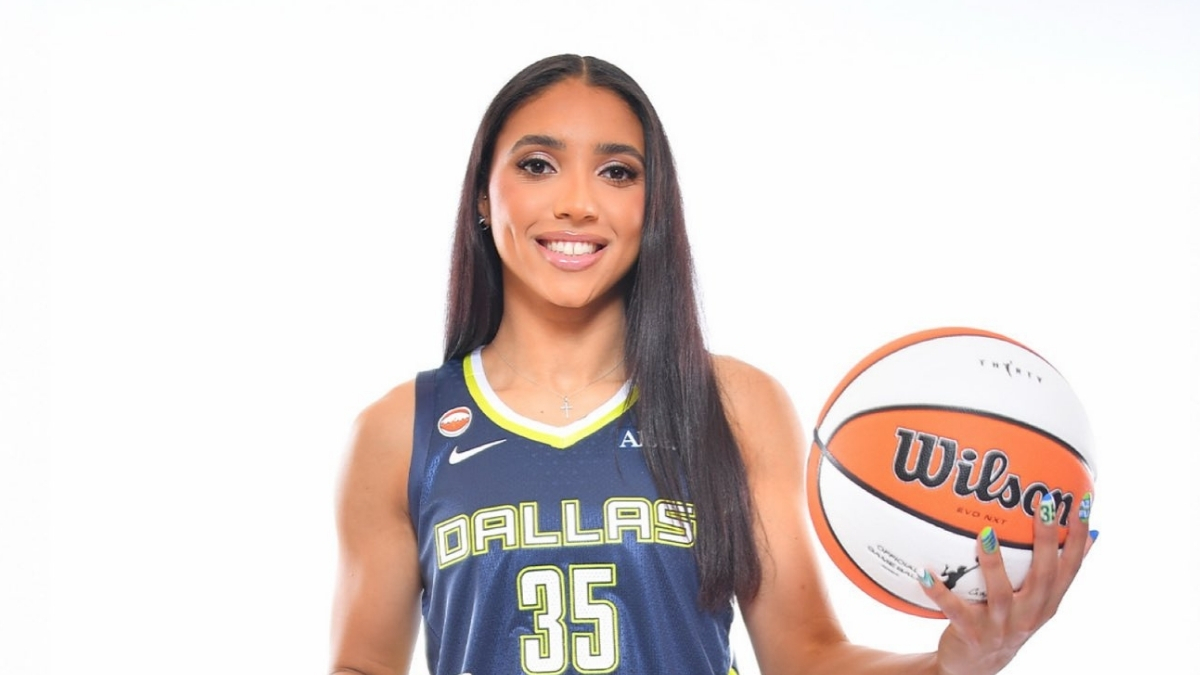
DALLAS — The Dallas Wings introduced Azzi Fudd as the No. 1 overall pick Thursday at a Hyatt Regency press conference. At the podium, general manager Curt Miller described his evaluation process. Head coach Jose Fernandez made the basketball case for the selection in detail. Fudd fielded questions about her physical preparation, defensive approach, development priorities, college program at UConn, family, plans for the Dallas community, and her message to Wings fans.
Kevin Sherrington chose to write about whether she is still dating Paige Bueckers.
That was a choice, but it wasn’t a journalistic one.
The Column That Got Written
Sherrington’s piece in The Dallas Morning News is framed as a press-freedom argument when it’s not. Instead, it was a media professional who leveraged two young women’s personal lives into 900 words of traffic, presenting that leverage as a principle, and the tell is in the column itself.
Sherrington repeatedly concedes that the relationship is not, in fact, a story. He concedes Bueckers made it public a year ago. He concedes other WNBA couples have played together, won titles together, and gotten married. He concedes the Wings have handled couples on the roster before. He concedes Fudd and Bueckers didn’t deserve the framing he was about to give them.
However, he filed the column anyway because the relationship angle drives traffic, and traffic is the point.
The Press Conference He Skipped
The Wings held two press conferences this week. The first took place on Monday night over Zoom, immediately after the draft. Miller and Fernandez went through a lengthy Q&A to discuss the entire process by which the front office identified the four players they viewed internally as having separated themselves from the rest of the options, the role free agency played in clarifying the pick, and the consultation with Bueckers and Arike Ogunbowale during the process. They also detailed the impact of the WNBA’s compressed calendar on their offseason moves and the roster-construction logic that produced the team Fudd joined on Thursday.
It was, in every respect, the press conference that a serious basketball columnist with an interest in covering the Wings attends. Sherrington did not.
By Thursday morning, the basketball case for the Fudd selection was already on the record in great detail, provided by the people who made the pick, in a setting designed for precisely that purpose. A columnist genuinely interested in the front office’s process or the construction of the roster Fudd was joining had everything he needed three days before the introductory presser even happened. There was an opportunity to ask the general manager or head coach. He could have written that column on Tuesday morning.
He chose to wait until Thursday and write a different one.
The Column That Should Have Been Written
Even at the press conference Sherrington attended, there was no shortage of basketball material about the No. 1 overall pick. Miller talked about the pressure of consecutive No. 1 picks and described the Wings’ draft evaluation process in plain language, using observations, scouting intel, and analytics to reach a conclusion on whom to select.
“When you have the No. 1 pick, you control the process,” Miller said. “The pressure isn’t as great as people think. We take an ‘eyes, ears, numbers’ approach, watching, gathering intel, and using analytics. That process ultimately points you to the right decision.”
Fernandez emphasized Fudd’s talent as a shooter, defensive development, and general fit with the team the Wings are building.
“Her basketball IQ, work ethic, leadership, and resilience,” Fernandez said. “When you look at our roster and what we did in free agency, she fits perfectly. She can space the floor, she’s willing to be coached, and she’s grown defensively. She stood out to me and our front office.”
Asked specifically how lineups featuring Fudd, Bueckers, and Arike Ogunbowale would work defensively, Fernandez answered that too.
“We’ll find out. We have 15 practices in 20 days before May 9, along with two exhibition games,” Fernandez said. “We’ll evaluate everyone and find the right combinations. People worry about defense, but other teams also have to guard them.”
That is what a roster-construction question sounds like when it is asked in good faith and answered on the record. Sherrington had access to every word of it. He wrote about something else.
The Precedent That Undercuts the Principle
Sherrington’s column frames the Fudd selection as the first time a Dallas front office has put two players in a relationship on the same roster and declined to account for it publicly. That framing requires pretending last season did not happen.
DiJonai Carrington and NaLyssa Smith played for the Wings together in 2025 as a couple. However, last season, The Dallas Morning News did not send a columnist to demand that the organization justify that pairing. There was no 900-word column framing their relationship as an unresolved culture risk that the front office owed the public an explanation for.
That is how this kind of coverage normally works. A front office builds a roster, whether or not it includes a couple. The team plays basketball. Nobody in the Dallas media market decides the arrangement is a franchise-level culture question requiring public litigation.
Then a high-profile name arrives, and the same arrangement becomes a crisis that demands a podium confession.
If the principle were genuine, it would have applied last year, but it didn’t. What changed is the traffic ceiling.
It is also easier, structurally, to assign the question to the columnist whose role is provocation than to a beat reporter who has to maintain working relationships across the franchise. When a newsroom routes Fudd’s first Dallas press conference to the writer paid to stir debate, that is not an individual call. It is an editorial decision about where to spend the outlet’s provocation, and who is safest to spend it on.
The Same Week, the Same Outlet
The Fudd column ran in the same week that The Dallas Morning News published two other pieces that, together, illustrate how the outlet allocates its critical energy across the Dallas sports landscape.
On April 13, sports reporter Brad Townsend published a lengthy interview with Patrick Dumont in which the new Mavs governor offered effusive praise for Jason Kidd. The piece is built on relayed quotes presented at length, without follow-up or challenge. Townsend even frames one of Dumont’s lines as “the most telling Dumont comment of all,” though the quote is merely an endorsement of the head coach. There is no scrutiny of the Nico Harrison firing, no challenge to the front-office decisions that reshaped the franchise over the past year, and no inquiry into ownership’s stewardship during the transition from the Mark Cuban era. Furthermore, there is zero pressure applied to the Adelsons’ pursuit of a new arena or on the public infrastructure conversations surrounding it. Ultimately, the piece serves as a vehicle for the governor to communicate to the fan base through the paper of record.
Two days later, on April 15, Sherrington filed a column framed in its headline as a tough-love message to the same franchise. However, a look at the actual content reveals otherwise. He endorses the front office’s preferred GM target. He defends the Adelsons against speculation of a Las Vegas relocation in language that reads like ownership PR, even instructing readers to “Repeat after me” before delivering the franchise’s preferred talking point. He frames the new arena push as a worldly inevitability he is too experienced to argue with. The headline-level criticism—that the Mavs should “act like a big-time franchise”—is abstract enough that no one in the organization could meaningfully disagree with it. It is a critical posture entirely devoid of critical content.
The energy is allocated by power. For example, the billionaire who fired his general manager in November and is actively negotiating for a new arena gets the deferential register. The 23-year-old WNBA rookie, whose access to the outlet is already mandated by league media policy and whose cooperation it does not need to earn, gets the lecture. There is no principled reading of those two editorial choices. There is only one version where the outlet protects its access and spends its critical energy on the people who cannot make it pay a price.
The Question That Wasn’t About Basketball
There is also the matter of what actually happened in that room.
“Paige announced last year on TikTok that you two were a couple,” Sherrington said. “Is that still the case, and have you talked to other couples in the league about navigating that dynamic as teammates?”
Wings public relations lead Pam Flenke answered on behalf of the team.
“I understand why you have to ask that question, but we’re going to respectfully decline from commenting on our players’ personal lives,” Flenke said.
Read that exchange twice. It is a communications professional acknowledging the reporter’s instinct and still declining, with grace, to discuss the personal lives of a player who did not come to the podium to discuss them. In response, Sherrington characterized it as something close to obstruction in his column.
Thursday was also the first time most of the Dallas media had been in the same room as Fudd. There are countless venues across the season ahead where editorial questions about a player can be raised in settings designed for that kind of conversation. Sherrington has access to every one of those. The Dallas Morning News had access to one of those avenues on Thursday. Like multiple local outlets, other personnel from the outlet spoke with Fudd in a one-on-one off the podium, away from the cameras and the family in the room. They did not raise the question of the relationship there. They raised it at the introductory press conference, with national media watching, where any response, including the polite decline that came, would go viral and convert into a column. The setting is the point when traffic is the goal.
The “we ask male athletes about their personal lives, too” defense cannot carry that framing. Coverage of male athletes’ relationships is overwhelmingly event-driven, whether it’s an engagement, a wedding, a podcast appearance the player agreed to sit for, or a feature the player participated in. It is not a columnist cornering a 23-year-old at her introductory press conference and treating a polite decline from the team’s PR lead as evidence of a cover-up.
Bueckers is not contractually obligated to provide status updates on demand, and neither is Fudd.
What the Column Actually Is
Newsrooms have always had traffic incentives. What makes this one worth writing about is the gap between what the column claims to be and what it is. It is not a defense of press access or a roster-construction analysis. It is not even a principled argument against the front office’s philosophy. It is two public figures’ personal lives turned into a column, dressed up in journalistic language to make it feel respectable, while the goal is to chase clicks.
Fudd is 23, while Bueckers is 24. They have both made basketball the center of everything they do in public. They are entitled to the same baseline professional courtesy that The Dallas Morning News has extended to every male athlete it has ever introduced in this city in my time covering basketball.
Thursday was a test of whether they would get it, but this column is the answer that they apparently will not.
More Wings Coverage on Dallas Hoops Journal
- Odyssey Sims Becomes 22nd Player To Sign With Dallas Wings Before Training Camp
- ‘Landed Where I Was Meant to Be’: Azzi Fudd Introduced By Dallas Wings, Embraces New Journey
- Exclusive: Curt Miller On The ‘New-Look’ Dallas Wings, Frontcourt Chemistry, And Azzi Fudd’s Elite Ceiling
- ‘We’ve Known For A Little While’: Greg Bibb On Why Azzi Fudd Was The Only Choice For Dallas
- ‘She Was The Right Fit’: Jose Fernandez And Curt Miller Detail Drafting Azzi Fudd, Dallas Wings’ Free Agency Moves
- ‘Nothing I Could Have Imagined’: Azzi Fudd Reacts To Dallas Wings Selection And Paige Bueckers Reunion
- ‘Ecstatic To Add Her’: Curt Miller Breaks Down Azzi Fudd As No. 1 Pick For Dallas Wings
- Dallas Wings Select Azzi Fudd No. 1 Overall, Reuniting Her With Paige Bueckers
- ‘Our Top Target’: Dallas Wings Sign Reigning WNBA Co-Defensive Player Of The Year Alanna Smith To Three-Year Max Deal