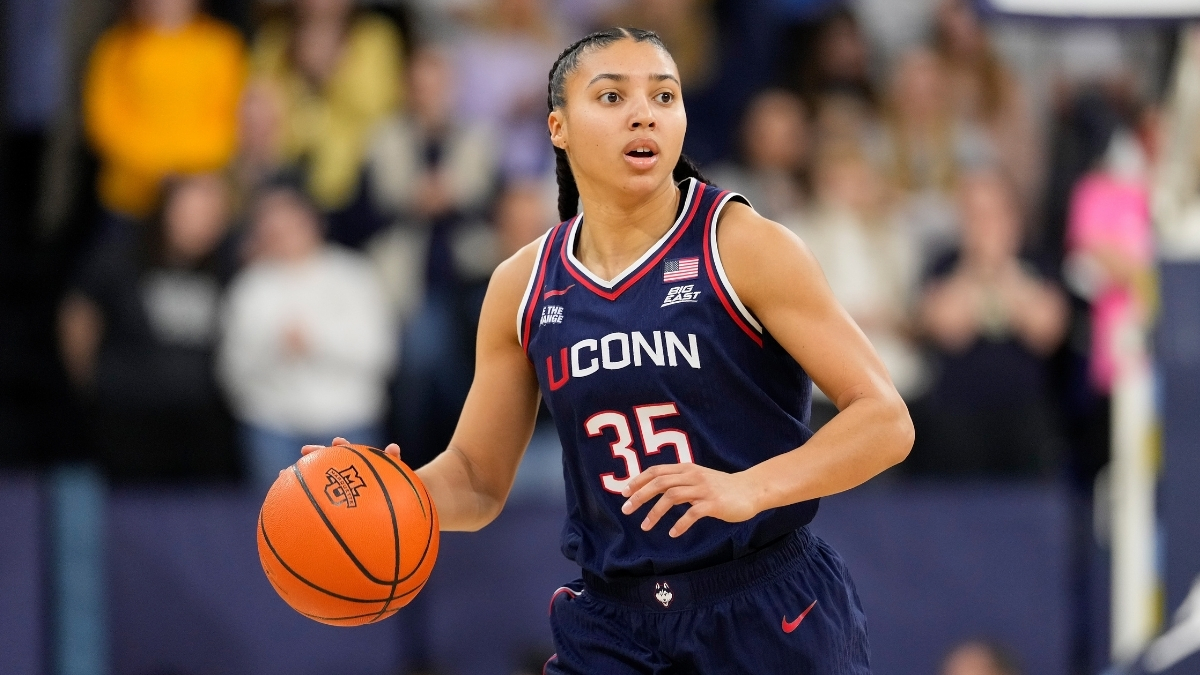
The Dallas Wings didn’t just win the 2026 WNBA Draft lottery — they won control of the conversation.
After securing the No. 1 overall pick, the franchise now sits at the center of one of the most consequential decisions in recent league cycles. Dallas is rebuilding around Paige Bueckers, recalibrating its identity and looking to turn close losses into sustainable contention. With the top selection months ahead of draft night, the Wings aren’t simply picking first — they’re defining their trajectory.
That’s where the Azzi Fudd-to-Dallas discussion gains momentum.
The idea isn’t built on hype alone. It’s built on fit, timing, and the type of perimeter skill set that has increasingly shaped winning formulas in the modern WNBA. But before any scenario becomes reality, one critical step remains.
Is Azzi Fudd Really Coming to the Dallas Wings?
At this stage, it’s a strong projection — not a finalized outcome.
Major outlets have connected the UConn guard to Dallas in early mock drafts for the 2026 WNBA Draft, noting that a formal declaration from Fudd would significantly reshape 2026 WNBA season picks at the top of the board. If she enters, the Wings’ decision at No. 1 becomes far more defined, and the rest of the lottery could shift accordingly. But mock drafts are simply projections. The most important variable remains straightforward: Fudd must formally enter the draft.
Fudd returned to UConn for the 2025–26 season, which the program indicated would be her final year of eligibility. Under the WNBA’s eligibility guidelines for domestic players, prospects typically enter the draft once they have exhausted or renounced their remaining NCAA eligibility and satisfy age requirements.
On the court, she is making the strongest statistical case of her career. Through 28 games this season, Fudd is averaging 18.0 points, 2.6 rebounds, 3.0 assists, while shooting 49.7% from the field, 47.0% from three-point range, and 95.0% from the free-throw line. Her 60.8% effective field goal percentage highlights the efficiency behind her scoring gravity. Across 104 career games at UConn, she has averaged 14.6 points while converting 42.6% from beyond the arc.
So the clearest framing remains simple: Dallas owns the pick. Fudd is widely viewed as a leading contender. But her candidacy depends on declaration, and postseason performance can always reshape the draft board.
Why the Dallas Wings Fit Matters
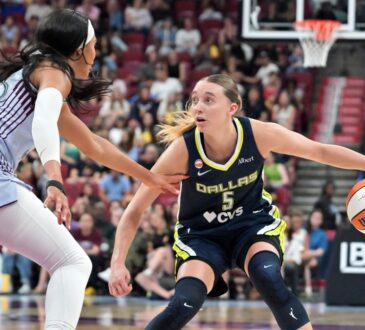
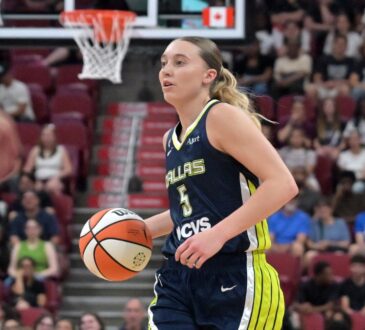
Dallas is positioned to sell upside after consecutive lottery appearances and a roster reset built around Paige Bueckers.
From a schematic standpoint, Fudd is more than a name — she is a solution. She would give Bueckers and the Wings an elite off-ball shooting partner who stretches the floor, punishes help defense and sharpens spacing in three-guard lineups.
Fudd’s gravity as a 40%+ career three-point shooter — nearly 47% this season — means weak-side defenders cannot load up on Bueckers’ pick-and-roll or off-screen actions without surrendering clean kick-out opportunities. That changes the geometry of Dallas’ offense immediately.
Because Fudd is arguably one of the best pure off-ball shooting prospects in recent WNBA draft history, Bueckers could toggle more freely between primary handler and cutter/relocator. Instead of constantly facing two defenders late in possessions — something Dallas has leaned on Bueckers and Arike Ogunbowale to solve — the Wings could weaponize movement shooting.
Fudd’s ability to run off staggered screens, flare actions and corner lifts occupies tag defenders and the low man, opening cleaner pocket passes and slot drives for Bueckers. In a high Spain pick-and-roll, for example, if Bueckers handles and Fudd lifts from the corner, any tag from Fudd’s side becomes a direct catch-and-shoot opportunity for one of the most efficient perimeter shooters available.
The blueprint is not theoretical. During UConn’s 2025 national championship run, Bueckers operated as the steady organizer while Fudd was the high-leverage scorer. In the Final Four win over UCLA (85-51), Fudd and Sarah Strong combined for 41 points while Bueckers added 16. In the national title game against South Carolina (82-59), Fudd and Strong each scored 24 while Bueckers added 17. Fudd was named Most Outstanding Player.
Their chemistry showed in sequences where Fudd’s defensive activity or shot threat created advantages that Bueckers finished or facilitated. That model — spacing, decision-making, and collective defensive pressure — translates cleanly to Dallas’ long-term build.
Other Top 2026 WNBA Draft Prospects Beyond Azzi Fudd
Still, No. 1 picks rarely come down to fit alone.
Lauren Betts (UCLA, C)
If Dallas values interior dominance and defensive anchoring, Betts presents a compelling alternative. The 6-foot-7 center is averaging 16.4 points, 8.4 rebounds and 3.1 assists this season while shooting 56.5% from the field. During her junior campaign, she averaged 20.2 points and 9.5 rebounds on 64.8% shooting. Across her career, she has shot 62.0% from the floor.
Selecting Betts would signal a philosophical pivot toward rim protection and interior control — traits that can stabilize a franchise quickly in the WNBA.
Olivia Miles (TCU, G)
Miles offers tempo control and playmaking. She is averaging 20.1 points, 6.8 rebounds and 6.5 assists while shooting 50.3% from the field and 36.4% from three. Her assist average mirrors her 6.5 career mark across 129 collegiate games.
A Bueckers–Miles pairing would emphasize dual initiators and half-court orchestration over pure spacing.
Awa Fam (Valencia Basket, C)
Fam represents long-term upside. The 19-year-old Spanish center is averaging 6.7 points and 4.2 rebounds while shooting 51.6% from the field and 80.0% from the line. Per 36 minutes, her production scales to 11.9 points and 7.4 rebounds.
If Dallas prefers ceiling projection over immediate schematic fit, Fam remains in the conversation.
Flau’jae Johnson (LSU, G)
Johnson combines scoring and defensive versatility. She is averaging 14.1 points, 4.5 rebounds, and 2.7 assists while shooting 47.4% from the field and 43.5% from three. Across 132 career games, she has averaged 14.6 points with a 38.0% career three-point mark.
For a team seeking wing flexibility and secondary scoring, Johnson offers another viable pathway at No. 1.
What Happens Next?
The Wings’ decision will ultimately come down to identity. If the priority is maximizing Paige Bueckers immediately — spacing the floor, relieving defensive pressure, and refining late-game execution — Azzi Fudd presents one of the cleanest schematic fits in recent draft cycles.
If Dallas values size, defensive anchoring, or long-term development arcs, other prospects present legitimate cases.
For now, the facts remain unchanged: Dallas holds the No. 1 pick. Azzi Fudd is a leading projected candidate. But draft outcomes hinge on declaration decisions, postseason performance, and front-office philosophy.
Until the draft pool is finalized, “Fudd to Dallas” remains a projection — not a guarantee.