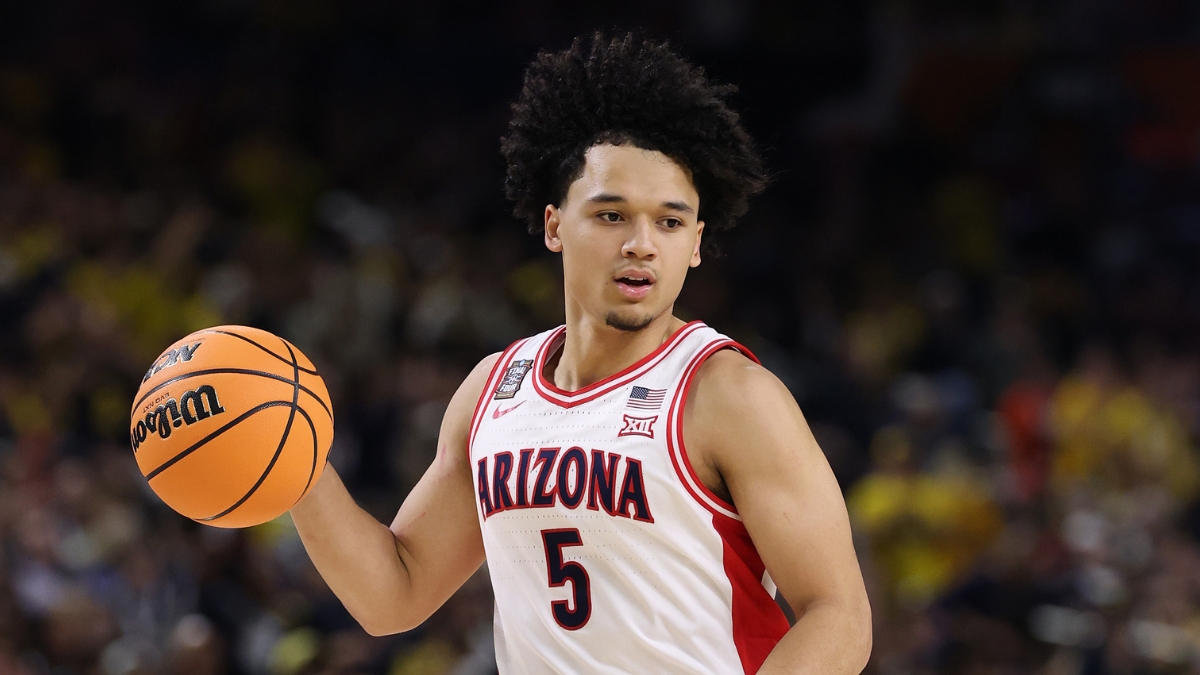
DHJ Quick Take: Why Brayden Burries Could Fit the Mavericks at No. 9
Arizona guard Brayden Burries doesn’t match Masai Ujiri‘s usual preference for long, athletic defenders, but his shooting and point-of-attack defense could make him a strong complement to Cooper Flagg.
- What does Burries do well? He hit 39.1% of his 4.6 threes per game as Arizona’s top option, defends the point of attack, and scores well in the midrange.
- What are the concerns? At 6’4″ with a 6’6″ wingspan and just 2.4 assists per game, he’s neither a primary playmaker nor a switchy, versatile defender.
- Why does he fit Dallas? With Cooper Flagg as a point forward, the Mavericks need a three-and-D guard more than a lead creator, and Burries’ defense works in multiple schemes.
- What’s next? The Mavericks hold the No. 9 pick in the 2026 NBA draft on June 23, with private workouts set to shape the decision.
It’s unclear what direction the Dallas Mavericks may take with the ninth overall pick in the 2026 NBA draft.
There’s been speculation that they could trade down. It’s a possibility. That said, there’s always risk involved in that move if you’ve got your eye on a prospect. If you’re invested in someone, it could be more sensible to just grab them from the spot you’re in.
Should Arizona’s Brayden Burries be that guy for the Mavericks?
Dallas Mavericks Could Target a Guard With the Ninth Pick
When it comes to Burries, there are pros and cons. Let’s start with the positives.
He’s a knockdown shooter. Burries hit 39.1% of his 4.6 threes per game this year. That’s a strong mark, but it’s even more impressive in context. Burries was Arizona’s first option by a wide margin, so he hit those threes despite intense defensive scrutiny. He’s also impressive when operating in the midrange.
Burries is also a stout point-of-attack defender. He’s a strong guard who won’t be easily powered through, and he’s got enough lateral mobility to keep up with his assignment.
Now, for the cons. Burries isn’t a perfect prospect. If he were, he wouldn’t be on the board at No. 9. Starting with offense, his 2.4 assists per game are problematic. Burries is strongly inclined to score the ball. That’s particularly concerning when he, at 6’4″, is the size of a point guard.
That brings us to some defensive shortcomings. Burries is solid, but with a 6’6″ wingspan, he’s not especially versatile. He’ll never be accused of being a defensive liability, but he may not be a game-changer on that end either.
That might not suit Masai Ujiri. His preference for long, athletic defenders is well documented.
Could it keep him from drafting Burries?
Dallas Mavericks Should Be Open-Minded to Burries
It shouldn’t! First, Burries’ limited playmaking chops are less of a concern with Cooper Flagg on the roster. He’s a point forward. If the Mavericks are building their offense around Flagg, having a three-and-D shot creator at the one becomes more palatable.
Defensively, the Mavericks don’t have to build a switch-everything scheme. If anything, Ujiri got in some trouble in Toronto by insisting that every player in the rotation was either a wing or wing-adjacent. A strong guard who can defend his man as well as Burries can is someone you can work into multiple defensive schemes.
None of which is to say Burries should be the de facto choice for Dallas. To make that decision, they need to rely on their internal evaluations and their private workouts. Still, from this vantage point, Burries looks like someone who could complement Flagg for years to come.
That would be the right direction for this organization.
More Mavericks Coverage on Dallas Hoops Journal
- Dallas Mavericks 2026 NBA Draft: The Case For Trading Down With The Oklahoma City Thunder
- Dallas Mavericks Enter Option Agreements For Former Valley View Mall Site For New Arena
- Dallas Mavericks Star Kyrie Irving Says He’s ‘Close To Being Over At 100%’ In ACL Recovery
- Mike Schmitz Says Dallas Mavericks Are ‘Looking At Everything’ For Next Head Coach
- Mike Schmitz Sees Kyrie Irving ‘Completely Locked In’ Around Dallas Mavericks Facility
- Why Masai Ujiri Parted With Matt Riccardi But Kept The Door Open For Michael Finley
- Sources: Multiple NBA Contenders Interested In Trading For Dallas Mavericks’ Kyrie Irving
- Why Masai Ujiri Moved On From Jason Kidd To Build Around Cooper Flagg
- Dallas Mavericks ‘Mutually Agree’ To Part Ways With Jason Kidd, Begin Search For Head Coach
- Why Keeping Kyrie Irving Is The Smartest Move For Cooper Flagg’s Early Timeline
- Mike Schmitz Opens Up On Quick Rise To Dallas Mavericks GM Chair