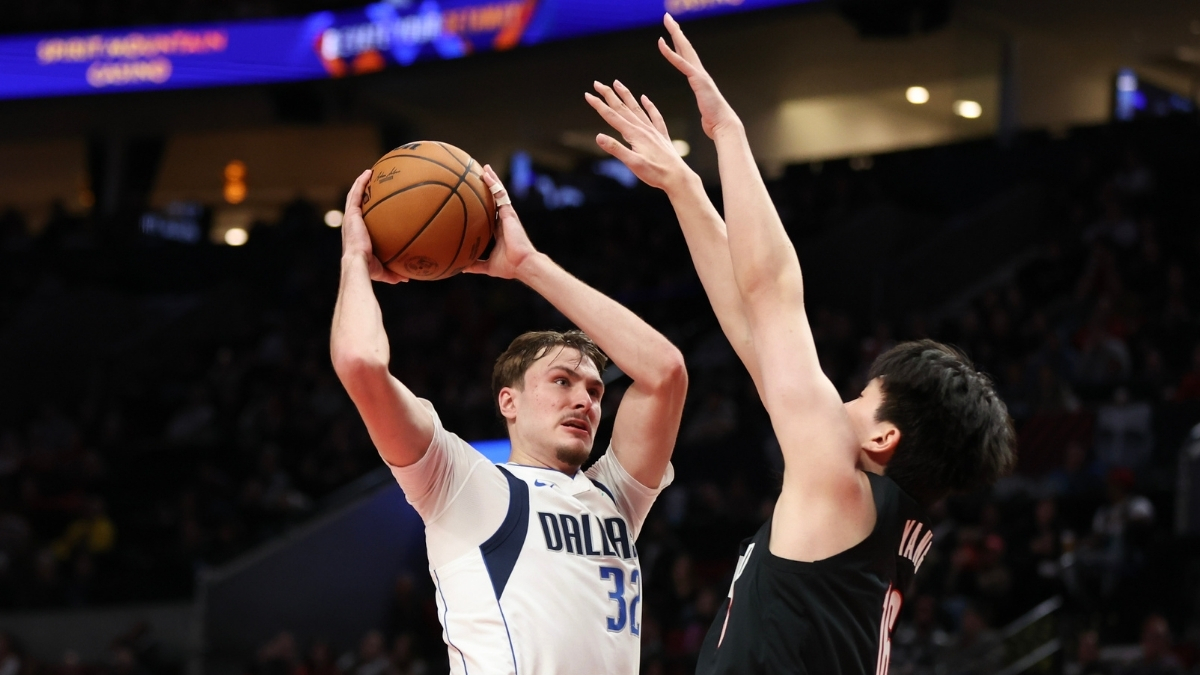
The Dallas Mavericks aren’t operating under any illusions about where they stand. At 21–36 and 12th in the Western Conference, they remain mathematically alive in the play-in race. But after trading Anthony Davis at the deadline, the organizational direction is unmistakable. This is no longer about squeezing out marginal short-term gains. It’s about building a sustainable core.
Moving Anthony Davis was a timeline decision. Dallas opted for flexibility, internal development, and draft positioning over trying to force contention in a season already derailed by injuries. With Dereck Lively II sidelined by season-ending foot surgery and multiple backcourt absences reshaping the rotation, the Mavericks have pivoted toward long-term evaluation.
And with a projected top-10 pick on the way — one of the few premium first-round assets the franchise will control before 2032 — the margin for error is slim.
Cooper Flagg is the Franchise Cornerstone
If there is one certainty to come from this transitional season, it is Cooper Flagg’s trajectory.
The 19-year-old forward is averaging 20.4 points, 6.6 rebounds, and 4.1 assists in 34.1 minutes per game. He is shooting 48.2% from the field, over 53% on two-point attempts, and 80.4% from the free-throw line. The three-point shot (30.2% on 3.5 attempts per game) remains a development area, but the overall production profile already resembles that of a primary offensive option.
Defensively, Flagg changes possessions. His length and anticipation allow him to guard multiple positions, rotate instinctively from the weak side, and contest at the rim without excessive fouling. Offensively, he attacks closeouts, pushes in transition after defensive rebounds, and generates free throws — a key pressure valve for a team still refining its half-court structure.
For fans analyzing performance trends and matchup edges, Flagg’s across-the-board production makes it easier to build an NBA parlay on FanDuel around points + rebounds + assists or all-around stat lines instead of relying solely on team outcomes.
P.J. Washington Remains a Key Frontcourt Presence
This has not been P.J. Washington’s most efficient season, but his importance has not diminished.
Washington is averaging 14.3 points, 7.1 rebounds, and 1.9 assists in 31.0 minutes per game. His three-point percentage (30.6% on 4.0 attempts per game) reflects a down year from deep, yet he continues to space the floor, defend multiple positions, and absorb physical matchups.
With Anthony Davis traded and Dereck Lively II unavailable, Washington’s ability to stabilize the frontcourt has grown in importance. He frequently draws difficult defensive assignments and contributes as both a primary and help defender, reflected in his 1.0 steal and 1.3 blocks per game.
Even during a transitional year, his versatility allows Dallas to experiment with combinations without completely sacrificing structure.
Naji Marshall and Max Christie Are Growing Into Expanded Roles
Injuries have forced Dallas to stretch its perimeter depth, and both Naji Marshall and Max Christie have responded.
Marshall is averaging approximately 15.2 points, 4.9 rebounds, and 3.0 assists while shooting 53.0% from the field. He attacks downhill, absorbs contact, and provides secondary ballhandling when needed. In games where the rotation tightens, his usage has spiked into 20-plus-point territory, giving Dallas a physical scoring presence on the wing.
Christie, meanwhile, has delivered one of the most efficient campaigns on the roster. In nearly 30 minutes per game, he is averaging 13.3 points while shooting 46.8% from the field and 42.3% from three on 5.7 attempts per game. His 59.1% effective field goal percentage underscores his value as a floor spacer alongside Flagg.
Both players are being evaluated not just as complementary pieces, but as potential long-term rotation staples in a Flagg-centered system.
Dereck Lively II and Kyrie Irving Are Central to Next Season’s Outlook
The current ceiling is limited, but the outlook shifts once key pieces return.
Dereck Lively II underwent foot surgery and is out for the remainder of the season, but he is expected to be healthy to begin next year. In his limited seven-game sample, he averaged 4.3 points, 5.3 rebounds, 1.9 assists, and 1.6 blocks in just 16.4 minutes while shooting 61.1% from the field. His rim protection and vertical spacing were intended to anchor Dallas’ defensive identity.
Kyrie Irving has also been ruled out for the remainder of the season to fully recover from ACL surgery. The organization expects him to be ready next year. His return will significantly reshape the offensive hierarchy, easing playmaking pressure on Flagg and restoring a late-game shot creator the roster currently lacks.
The absence of both players has lowered the immediate ceiling. Their presence next season raises it considerably.
The Top-10 Pick and General Manager Hire Will Define the Next Phase
The Anthony Davis trade clarified the timeline, but one major question remains unanswered.
Dallas has yet to hire a new general manager.
That decision will determine how aggressively the Mavericks build around Cooper Flagg, how they approach the upcoming top-10 pick, and how they balance veteran presence with long-term flexibility. With limited control over future first-round picks until 2032, the front office cannot afford missteps.
The remainder of this season is about information — identifying which players scale alongside Flagg, which lineups hold defensively, and what gaps must be addressed before Lively and Irving return.
The Mavericks have their franchise cornerstone. They have key reinforcements expected next season. They have a premium draft asset approaching.
Now they need clarity at the top to define exactly how the next phase unfolds.