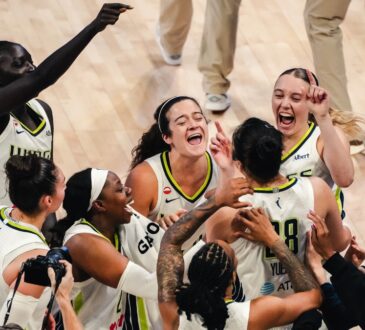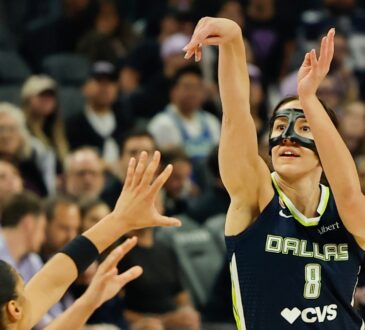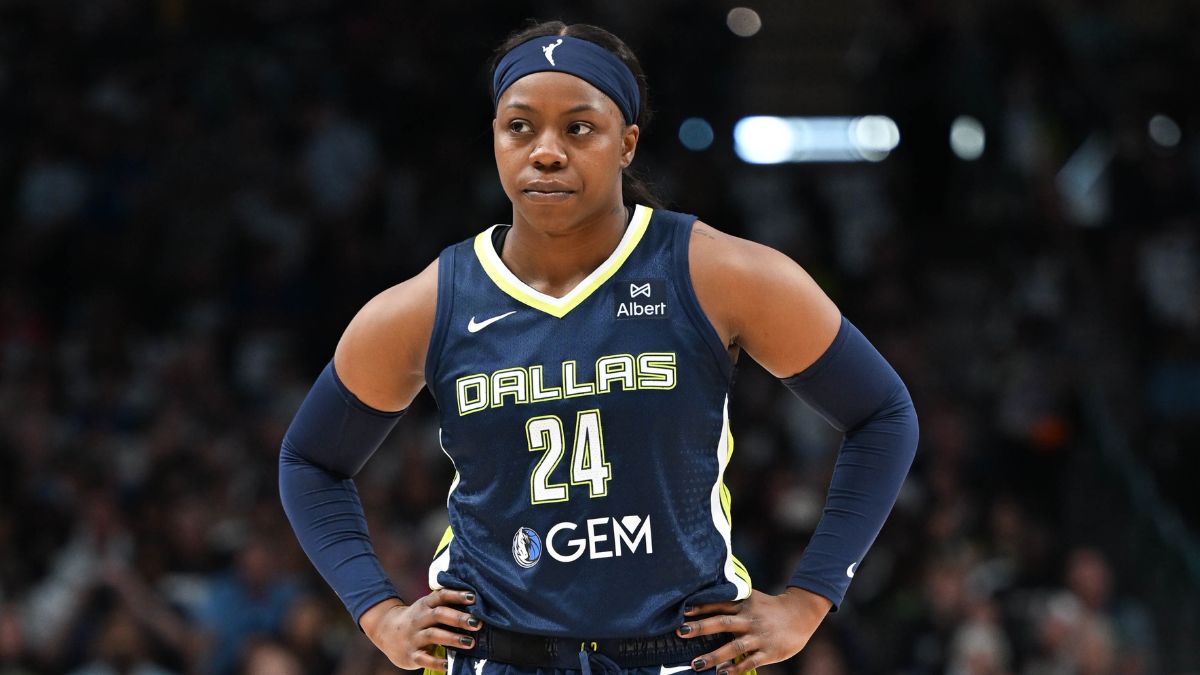
The Dallas Wings are not simply entering another offseason. They are stepping into a structural crossroads that will define the early years of the Paige Bueckers era, with a thin 2026 books sheet, a massive Arike Ogunbowale decision, and a second straight No. 1 pick all converging at once.
Dallas finished 10-34, seventh in the WNBA Western Conference, under head coach Chris Koclanes and general manager Greg Bibb. The record reflected a team caught between development and instability. The Wings averaged 81.7 points per game (9th of 13) but allowed 88.0 points per game (12th of 13), resulting in a -7.9 net rating that ranked 11th in the league. Their pace of 78.8 possessions per game was second fastest in the WNBA, but the efficiency lagged behind: a 103.3 offensive rating (10th) paired with a 111.2 defensive rating (11th).
The expected win-loss projection of 14-30 underscored how thin the margins were. Dallas played fast. It did not play clean.
Back-to-back No. 1 picks have given the Wings premium draft capital, and Bueckers’ Rookie of the Year emergence has provided the franchise with a legitimate cornerstone. But beneath that momentum sits a fragile reality: only a small cluster of players is firmly under contract or team-controlled beyond 2025, leaving Dallas with one of the thinnest multi-year foundations in the league and a wave of free-agency decisions that could reshape nearly the entire roster.
This is not a summer for minor adjustments. It is a moment that will determine whether Dallas accelerates into sustained contention or resets yet again.
At the same time, fan engagement around women’s basketball continues to surge. Interest in the Wings increasingly extends beyond game nights into film breakdowns, fantasy contests, and even online gaming platforms such as Dude Spin, where fans who enjoy the entertainment side of sports culture can stay plugged in between WNBA seasons.
The Dallas Wings’ Thin Long-Term Base
When you isolate only players firmly under contract or clearly team-controlled for 2026, the core becomes surprisingly small.
Paige Bueckers, Maddy Siegrist, Diamond Miller, Aziaha James, and JJ Quinerly form the clearest multi-year building blocks. All are on rookie-scale deals or recent additions, the organization has treated as part of its future. The Wings also hold reserved rights to Lou Lopez-Sénéchal and maintain control of several bigs — including Luisa Geiselsöder, Li Yueru, and Awak Kuier — whose rights give Dallas frontcourt optionality even if their long-term roles are not yet defined.
That group represents the true structural base. Everyone else is essentially an active decision rather than an automatic fixture.
Nearly the rest of the 2025 roster sits in some form of uncertainty — unrestricted or restricted free agency, short-term deals, or non-guaranteed situations that require deliberate renewal. Dallas has flexibility, but it does not have stability, and that distinction will define how aggressive the front office can be around Bueckers over the next two years.
Paige Bueckers As The Organizational Axis
Everything now runs through Paige Bueckers.
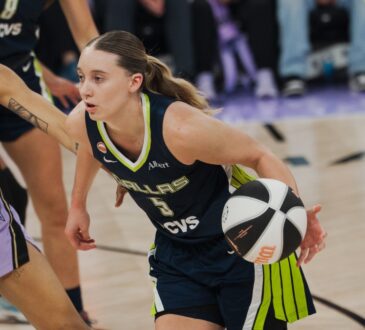
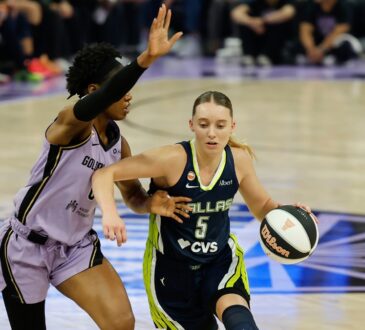
Her Rookie of the Year campaign validated Dallas’ decision to hand her the offense immediately. In 36 games, she averaged 19.2 points, 3.9 rebounds, 5.4 assists, and 1.6 steals while shooting 47.7% from the field and 88.8% from the free-throw line. She handled a 33.3-minute workload from day one and functioned as the team’s primary offensive initiator, dictating tempo on a roster that ranked second in pace but 10th in offensive rating.
She operated as a true three-level scorer, controlled space in pick-and-roll, and displayed late-game composure that typically takes veterans years to develop. On a rookie-scale contract, she already profiles as an All-WNBA-caliber offensive engine — the single most valuable competitive advantage a franchise can hold.
Around her, the Wings have begun assembling a perimeter group that aligns with that timeline. Aziaha James averaged 7.5 points and 2.9 rebounds in 17.7 minutes per game, flashing self-creation and defensive versatility. JJ Quinerly contributed 6.5 points, 1.9 rebounds, and 2.3 assists in under 16 minutes per night while shooting 38.9% from three, earning rotation trust after fighting through a crowded training camp.
Together with Bueckers, they give Dallas young, cost-controlled perimeter talent that can grow in concert rather than on separate arcs.
But that trio alone does not define a contender. It defines a foundation. To translate star-level guard play into playoff wins, the roster must be structurally aligned — particularly in terms of rim protection, defensive rebounding, and interior deterrence — around them.
Jose Fernandez And The Identity Question
New head coach Jose Fernandez now inherits that alignment challenge.
Dallas went 10-34 under Chris Koclanes with a -7.9 net rating, ranking 11th in defensive rating at 111.2. The Wings played fast — second in pace — but often struggled to convert speed into structure. Too many possessions ended in difficult, late-clock jumpers or defensive breakdowns on the other end.
Fernandez arrives with a 25-year résumé at South Florida built on discipline, player development, and defensive accountability. His task is clear: slow the chaos without dulling the talent.
The Wings allowed 88.0 points per game, second-worst in the league. Defensive rebounding lapses and pick-and-roll coverage breakdowns repeatedly undercut competitive stretches. Fernandez’s emphasis on help-side rotations, paint protection, and clearer late-game hierarchy directly targets those weaknesses.
And that makes the next decision even more consequential.
The Arike Ogunbowale Decision
Arike Ogunbowale averaged 15.5 points, 2.5 rebounds, and 4.1 assists in 29 games while shooting 36.4% from the field and 30.4% from three. Her free-throw efficiency remained elite at 93.1%, but her overall shooting profile reflected a season where spacing and rhythm were inconsistent.
She remains one of the league’s most explosive scorers and a defining presence for the franchise. Yet she enters free agency at the exact moment Bueckers’ timeline becomes central to every structural choice.
Dallas has three realistic paths: core her on a one-year supermax, negotiate a longer-term extension aligned with Bueckers’ arc, or explore trade pathways that redistribute usage and reallocate cap space toward frontcourt balance.
The philosophical question is unavoidable.
Can the Wings sustainably build around two high-usage perimeter scorers while ranking 11th in defensive rating? Or does the roster need to tilt toward rim protection, rebounding, and lower-usage defensive anchors to maximize Bueckers over the next five seasons?
There is also expansion pressure. If Dallas declined to protect Ogunbowale and did not use a core tag, an expansion franchise could select and core her. That outcome remains unlikely — the Wings can protect, core, or trade her — but indecision carries risk.
If Dallas wants to control the outcome, it must act deliberately.
The Dallas Wings’ Wave Of Expiring Decisions
Ogunbowale is not the only decision point.
Myisha Hines-Allen averaged 7.6 points, 6.0 rebounds, and 2.9 assists across 40 games, providing physicality and interior stability. Maddy Siegrist added 12.7 points and 4.3 rebounds while shooting 49.1% from the field in 27 minutes per game, quietly becoming one of Dallas’ most efficient rotational pieces.
Luisa Geiselsöder averaged 6.9 points, 4.8 rebounds, and 1.6 assists in 22.4 minutes, spacing the floor at 33.0% from three while offering positional versatility. Li Yueru contributed 7.4 points and 5.8 rebounds in 20 minutes per game, showing flashes of interior scoring efficiency.
Those numbers illustrate the broader issue: Dallas does not lack playable frontcourt pieces. It lacks hierarchy and defensive cohesion.
Flexibility cuts both ways. With only a limited group firmly locked into 2026, the Wings have meaningful cap room and maneuverability. But sweeping turnover is also possible if evaluations and negotiations diverge.
The Dallas Wings And The Second Straight No. 1 Pick
Holding the No. 1 pick again magnifies the stakes.
Unlike the prior draft cycle, this class does not present a unanimous top prospect. The choice is philosophical.
Does Dallas reinforce perimeter skill — potentially adding another guard to a group that already ranked 10th in offensive rating? Or does it correct structural weaknesses — rim protection, defensive rebounding, and paint deterrence — that contributed to an 11th-ranked defensive rating?
Spanish center Awa Fam represents the structural swing: size, mobility, vertical spacing. UConn guard Azzi Fudd represents the skill and spacing play. Guards like Olivia Miles introduce further playmaking layers if Dallas reshapes the backcourt.
Because the guaranteed core is thin, this pick will define more than depth. It will define identity.
With Bueckers averaging 19.2 points, 3.9 rebounds, and 5.4 assists on a rookie-scale contract, Dallas holds cost-controlled star production. That window is the league’s most valuable asset.
It demands decisiveness.
Why The Dallas Wings Face A Genuine Reset Point
The combination is rare: a franchise centerpiece on a rookie contract, a minimal long-term cap sheet, multiple expiring veteran deals, back-to-back No. 1 picks, and a new head coach tasked with installing defensive discipline and role clarity.
This offseason is not about simply adding names. It is about choosing an identity.
Dallas can leverage its flexibility to accelerate into playoff stability by locking in the right veterans, drafting with structural intent — particularly at center — and clarifying its hierarchy around Bueckers so that roles are unmistakable on both ends of the floor.
Or it can drift, misjudging contracts, duplicating perimeter skill sets, and entering 2027 still searching for alignment between its star, its coach, and its roster construction.
The Wings are not talent-poor. They are alignment-dependent.
And alignment is more difficult than accumulation.
This summer will define whether the Bueckers era begins with precision — or prolonged recalibration.