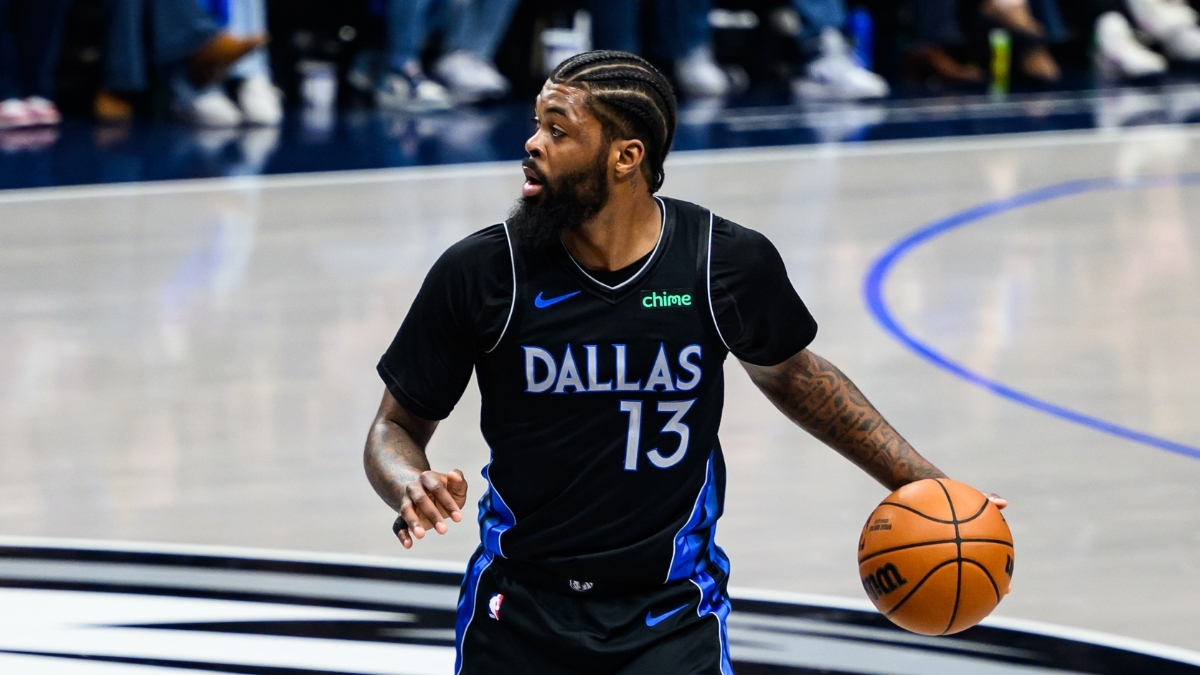
The Dallas Mavericks have not had the luxury of stability for most of this season, yet they’ve found a way to stack results anyway. Dallas enters this stretch at 19–26, riding a four-game winning streak and trending upward in a Western Conference race that has demanded constant adjustment — in lineups, in roles, and in responsibility — on a nightly basis.
It’s the environment where Naji Marshall’s season stops looking like a hot streak and starts reading like a profile shift. What has emerged is a year built on availability, force, and a role that has quietly expanded from complementary wing into something closer to a functional organizer. Dallas has needed someone who can absorb responsibility without changing the team’s personality, someone who can stabilize possessions when the floor tilts and games begin to fray at the edges. Marshall has become that player, and both the film and the numbers point in the same direction.
He has played all 45 games. He has started 22 of them. He is averaging 29.0 minutes per night, a workload that pushes a player beyond short-burst energy and into sustained accountability. At that level, the season stops hiding flaws. You either hold up physically and mentally, or the grind exposes you. Marshall has held up — then progressed — then scaled.
Across the season, he is averaging 14.5 points, 4.7 rebounds, and 3.0 assists, shooting 54.8% from the floor with a 63.9 true shooting percentage. Those numbers reflect efficiency, but they also reflect role clarity. He is no longer simply finishing plays created for him. He is initiating offense in pockets, extending possessions with his body, and making reads that allow Dallas to survive stretches without its preferred creators on the floor.
That growth has accelerated this month. In 11 January games, Marshall has averaged 18.0 points, 4.6 rebounds, and 4.5 assists, while maintaining efficiency and playing just over 30 minutes per game. The assist jump has been as clear as the scoring. It reflects how often the ball is finding him in advantage situations — not merely to finish, but to decide. When defenders stay home on shooters, he’s finishing through contact. When they collapse, the pass becomes available — often a beat earlier than expected.
And he has done all of this while living in the unglamorous areas of the game — paint touches, contact finishes, transition sprints, late-clock reads — where reliable production is less about shooting variance and more about body control, conditioning, and repetition. It’s the kind of growth that shows up on film first, then reveals itself in the data.
Growth That Shows Up on Film and Data
Jason Kidd has increasingly spoken about Marshall less like a wing who fills gaps and more like a player who drives the team’s shape—where the ball goes, how the offense settles, and how the group competes on the other end.
“He’s been playing the point guard great,” Kidd said Friday. “He’s getting to his spots on the floor, but defensively he’s competing, and then being able to make plays for others. He’s doing everything for us.”
That assessment holds up in the details. It’s true in how Dallas uses him—more on-ball responsibility, more decisions made at speed—and it’s true in his efficiency profile. Marshall’s overall output isn’t being propped up by low-leverage minutes or a fragile shot diet. His season profile reads like a player generating real points from real contact.
Marshall’s overall points per possession sits at 1.147 (88th percentile) with shot-quality grading that lives comfortably in the “Very Good” to “Excellent” range across the areas that match his style. His finishing is the backbone: he isn’t surviving on jumpers he doesn’t need. He’s operating like a downhill wing with a guard’s understanding of where pressure breaks defenses.
The biggest tell is that his production has grown as his minutes have grown—and Kidd framed that as a direct consequence of conditioning and professionalism, not randomness.
“Minutes. You’re playing a lot of minutes—you have no choice but to get in shape,” Kidd said. “But once you start playing that range of 35 minutes, you have to understand what it means to maintain and perform. He’s taken that very seriously. As his conditioning has improved, he’s improved. We’re asking him to play both ways—offense and defense—and he’s been very sharp for us mentally and physically.”
It’s evident in the way the year has moved month to month. October is short minutes and short output; November is heavier usage and better scoring; December is a major efficiency jump; January becomes the version that feels like a genuine step forward—larger role, more playmaking, bigger nights. Those aren’t isolated spikes. They’re the product of a player whose legs don’t disappear late in games.
Marshall described that change himself after the win over Golden State, and he did it in the language of someone who understands the mental side of fatigue.
“I think my conditioning,” Marshall said when asked where he has grown most individually. “I’m able to play at full speed longer. I think a lot of people, when they get tired, they don’t think as much — they turn their brain off and stuff. So I think it’s really helping me just stay locked in the game, defensively, and being able to run in transition.”
An Elite Floater That Defenses Cannot Stop
The easiest way to reduce Marshall’s rise is to call it hustle and opportunity. The more accurate read is that he has developed a specific scoring tool that fits what Dallas needs, and the league’s tracking reflects it.
Marshall is not just “good” on floaters this season. He is producing them at a level that puts him on a list most people would never expect a wing to touch.
Among the league leaders in total floater points, Marshall ranks sixth, behind names like Donovan Mitchell, Jalen Brunson, and Luka Dončić. The efficiency is the louder part: 1.360 points per possession on floaters, with 66.3% conversion. The shot is not simply an accent. It’s a pressure valve.
Marshall knows it has become visible.
“It’s kind of getting too much recognition,” he said. “I feel like people are starting to figure me out a little bit, so I need people to calm down, just let it be what it’s going to be. But it’s just a testimony to the work — just putting in the work, trusting my work out there, and just going with what feels comfortable.”
Marshall isn’t surprised by it. He sees it as a product of work and comfort—repeatable mechanics and a shot he can access against real defense.
And it dovetails with what opposing evaluators see when they watch Dallas. One Western Conference scout recently shared an evaluation of Marshall’s season-wide impact with DallasHoopsJournal.com that aligns with the way Dallas has begun relying on him—the floater is framed as part of a broader stability package.
“Naji Marshall is someone that settles the Mavericks down pretty much every time I’ve watched them play,” the scout told DallasHoopsJournal.com. “He plays through contact so well. His finishing has been great. His floater has always stood out. He keeps getting better.”
“He’s in great shape,” the scout added. “He’s taken pride in tough defensive assignments. He brings value on both ends. That’s a player you want next to Flagg.”
That last line is the key: “next to Flagg.” This season is not only about how Marshall plays in the current rotation; it’s about how his style scales alongside a foundational piece. A player who can initiate, play through contact, and defend up the chain becomes even more valuable in a roster-building context, because it reduces the number of “specialist-only” minutes a team has to carry. Having multiple players who can break down a defense to score or create advantage is essential.
Marshall continues to carve out a sustainable role for a player who can be part of a winning ecosystem.
Jason Kidd is Trusting Naji Marshall’s Point-Forward Skills
Kidd’s best insights on Marshall have been about passing, not scoring—because passing is what determines whether you can actually function as a connector or point-forward in key moments.
“His vision. His IQ. Understanding plays, who’s open, what the defense is giving you,” Kidd said. “I thought before halftime he made some really good plays offensively with the pass—one wasn’t converted, one was. When you’re on the floor with him, you have an opportunity to get the ball.”
Kidd then tied Marshall’s growth to lineup flexibility—how you build functional offense when your roster is constantly shifting.
“It’s big when you have another ball handler who understands the basketball IQ—who’s open, what the defense is giving you,” Kidd said. “When you have someone like Naji who can play all five positions in that sense, it makes it fun as a coach and fun for his teammates.”
The more a player can do without breaking the team’s structure—handle, pass, defend multiple positions, play through contact—the fewer fragile lineups you’re forced into.
Kidd even described Marshall’s handling style in physical terms, the way a point guard would: speed control, sightlines, and the advantage of size.
“He’s comfortable with his speed. He has his own speed. He doesn’t have the Brandon Williams speed, but being 6-7—or 6-8, however he’s listed—smalls become big and bigs become small,” Kidd said. “His ability to see over the defense and his feel—he has a great basketball feel when he has the ball.”
You saw that feel in the Golden State game not as an abstract concept, but as production: 30 points and nine assists, with Marshall controlling pressure points all night. His own postgame comments framed the win like a release, not because of his stat line, but because of what it meant for a team that had lived in close games.
“Yeah, man, it’s been a long season,” he said. “You know, we played a lot of close games, so like you said, just to come out on top of this one, man, it’s an unbelievable feeling. You know, my emotions went wild for a second, but like I said, it’s been a long season. I’m just passionate about the win, about the team, about the fans who rock with us. So that’s really just what it was.”
He then put the larger arc into one clean thought—growth, patience, and a roster that has been learning in public.
“I think we’re just growing — just in general, in life,” Marshall said. “I think people are really quick to criticize, but like you said, we’ve been at a disadvantage basically without players. It’s a lot of young guys out there, a lot of people who’ve been in the NBA for the first time, so they’re just learning on the move. And for them to pick it up and just get better and better like that — unbelievable feeling to see. So just proud of my guys.”
The most revealing part is how Marshall talks about his own role within that ecosystem. He doesn’t describe himself as a scorer. He describes himself as a force.
“We understand our roles,” Marshall said when asked why his tandem with Max Christie works. “He’s more catch-and-shoot, off-the-dribble. I’m more downhill. We feed off each other. It’s fun sharing the floor with him.”
That “more downhill” line sounds simple, but it’s the entire blueprint. Downhill players collapse defenses. Collapse creates reads. Reads create shots. Shots create spacing. Spacing creates more downhill lanes. It’s a loop, and Dallas has been leaning on him to keep it spinning.
That trust from the coaching staff is echoed just as clearly inside the locker room, where Marshall’s impact is felt less in job titles and more in how possessions stabilize when he’s on the floor. Teammates consistently describe him not as a scorer or defender first, but as a problem-solver.
“Naji, he’s the knife,” Cooper Flagg said. “That’s his nickname for a reason. He just does a little bit of everything. He’s everywhere. He’ll cut up the defense, cut off the drive… When he’s just out there, we’re a better team. Defensively, he brings that dog… He’s such a win player.”
Brandon Williams described the effect in the most concrete terms possible: what defenders do when Marshall gets into the paint.
“Big. That floater is vicious,” Williams said. “When he gets into the paint, we all trust his abilities. He doesn’t always have to shoot it—he creates a lot. When he gets into the paint, everybody’s eyes go toward him. That allows other guys to back cut, Max to be open in the corner. Me and him slashing together—it’s great for us.”
And Christie, who has watched the same thing night after night, distilled it into identity.
“Naji is Mr. Consistent for us,” Christie said. “He shows up every single game and has been the same guy all year. He brings his energy and intensity on both sides of the ball, and he’s such a vital part of our team. He’s just really consistent, and that’s huge for us.”
Consistency is often the least glamorous compliment in the league. It’s also the one that front offices value the most, because it’s what survives playoff scouting and physicality.
Defense as the Constant, Not the Tradeoff
What makes Marshall’s offensive expansion sustainable is that defense is not being sacrificed. Long before arriving in Dallas, he built his reputation as a physical, on-ball defender with the New Orleans Pelicans — a player trusted to take difficult assignments and absorb contact without drifting out of scheme.
That identity has carried over, even as his offensive responsibility has increased.
“In New Orleans, he was already known as a physical on-ball defender,” a Western Conference scout told DallasHoopsJournal.com. “Dallas put more on his plate offensively last year than he’s handled before in his career. He’s looked great on both ends — the conditioning has been a big part of that. He’s getting into the ball and being physical in containment throughout games without hurting his offensive game.”
Another Western Conference scout echoed the sentiment.
“He’s disciplined, he’s strong, and you can put him on the ball without worrying about tradeoffs,” the scout told DallasHoopsJournal.com. “He’s always been someone who seems to really pride himself in taking on guarding the other team’s best player.”
Marshall has said as much himself — most clearly when discussing the challenge of guarding Luka Dončić, his former teammate and one of the league’s most demanding assignments. Dončić, who is averaging 33.4 points, 7.8 rebounds, and 8.7 assists this season, will look to follow up his only game as an opponent at American Airlines Center — a 45-point performance in a 112–97 Lakers win — while Marshall embraces the challenge of trying to contain him.
“Oh, for sure,” Marshall said when asked about taking the Luka assignment. “I love the challenge. I’m a dog, and I guard anybody. That’s just what it is.”
Marshall doesn’t frame elite assignments as burdens or exceptions. He rises to the challenge. It’s the type of mentality a team needs when establishing a defensive culture — a mindset that defense matters as much as scoring. That mindset is why his fit next to Cooper Flagg resonates league-wide. Two players who can guard, handle contact, and make decisions without needing protection don’t just coexist — they stabilize lineups.
“While the shooting could be better, he’s a perfect fit next to Flagg,” a Western Conference scout told DallasHoopsJournal.com. “That’s a perimeter tandem you can build around.”
Finishing Through Contact Has Helped Set the Tone
The most persuasive part of Marshall’s profile is that his efficiency isn’t floating on low-volume corner threes or one-week heater shooting. It’s built in the paint, with contact, in the parts of the game that tend to translate.
Marshall has executed 69.4% finishing at the rim, and among a player pool with 150+ possessions in that play type, that places him among the league’s most efficient finishers. That’s not “good for a wing.” That’s just good.
That physical reality is already shaping how opposing teams talk about him when preparing for Dallas.
“He’s one of those guys where you almost have to send the low man early,” a Western Conference executive said. “If you wait, he’s already shifted the defender and finished at a weird angle.”
Marshall doesn’t need a clean blow-by or speed advantage. His strength forces defenders to react early, and once their base is compromised, his touch takes over. By the time the help defender commits, Marshall is often already releasing the ball from below the rim line or extending it away from the shot-blocker’s reach.
An Eastern Conference scout described the challenge in similar terms, focusing on how difficult it is to match him cleanly with either position group.
“He’s too strong for most guards and too comfortable against wings,” the scout told DallasHoopsJournal.com. “If you put a guard on him, he walks them into the paint. If you put a wing on him, he’s still getting to his shoulder and finishing. You don’t really win either matchup straight up. He’s relentless.”
From a scouting perspective, that combination — physical force plus balance manipulation — creates a rare problem. Guards can’t sit on his handle without getting backed down. Wings can’t rely solely on length because he finishes through their chest and around their arms. The defense is forced to collapse not because of speed, but because of inevitability.
That collapse is where Marshall’s growth as a creator shows up.
As defenses begin tagging earlier, Marshall’s reads have sharpened. The same physical pressure that produces awkward-angle finishes also pulls weak-side defenders toward him sooner, opening passing windows before rotations are fully set. His assist growth reflects that evolution. He’s not just finishing through traffic — he’s drawing it with intent.
It also aligns with how Marshall describes his own offensive philosophy when shots don’t fall early.
“We work on our game every day,” Marshall said. “You miss some, you make some. If you don’t take the shot, you’ll never know. So just continue to shoot them. It’s just a testimony to our work and believing in each other.”
It’s the posture of a player whose offense is not dependent on pristine rhythm. A downhill finisher can miss early and still generate offense late because the rim doesn’t move, and the contact doesn’t scare him — he thrives off of it.
That’s why the month-to-month improvement is so intriguing. It’s not only that the points increased. It’s that the larger role didn’t break the efficiency, and in some stretches, it amplified it. When a roster is injured, teams often ask the wrong players to scale. Marshall has scaled without becoming inefficient.
Naji Marshall Takes Pride in Availability
Marshall’s season is not only about production and role. It is also about identity—how he sees himself, how he wants to be seen, and how seriously he takes simply being available.
That came through in a small moment that would be meaningless for most players and revealing for Marshall.
During a recent game, there was a rare update noting that Marshall went to the locker room late. Marshall saw it and quote-tweeted it with a message that was funny on the surface and deeply on-brand underneath.
It reads like a joke, but the subtext is consistent with everything else in his profile: he wants it understood that he doesn’t disappear, doesn’t fold, and doesn’t treat stepping away—physically or mentally—as normal.
A Dallas Mavericks Season That’s Still Building, Not Finishing
Marshall has been candid about the emotional arc of this year — how different the wins feel now, how heavy the early part of the season can get, and how much the fans stayed with the group even when the results didn’t justify it. That perspective is key, given the context Dallas has been operating in.
Over their last 10 games, the Mavericks have gone 7–3, a stretch that has come despite extended absences from Anthony Davis, Kyrie Irving, and Dereck Lively II, along with day-to-day lineup instability tied to P.J. Washington and Daniel Gafford. The continuity hasn’t been in the personnel. It’s been in the approach.
“Like you said, we were 4–12, and every game was still sold out,” Marshall said. “They still show us love. Whether we win or lose, they’re in every game cheering us on. So shout out to them.”
Those early losses forced the roster into accelerated growth. Young players were asked to handle real responsibility. Lineups changed nightly. Roles blurred. For Marshall, it meant playing more minutes, guarding tougher matchups, and shouldering more offensive decision-making without the safety net of a settled rotation. The results now look steadier, but the foundation was laid in the instability.
And as much as this has been a career year, Marshall has been equally clear that he doesn’t see it as a completed story.
“Most definitely,” Marshall said when asked if the wins feel different given the early record. “But we’re not satisfied. We’re still hungry. We’re still building.”
This isn’t a player having a good year in a vacuum. This is a player whose role is expanding in a way that fits modern playoff basketball — downhill pressure, rim finishing, a floater that punishes drop coverage, passing that keeps spacing alive, and defensive competitiveness that coaches trust regardless of matchup.
Latest Dallas Mavericks News & NBA Trade Rumors
- NBA News: ‘He’ll Be Ready’: Dallas Mavericks Regain Daniel Gafford Before Facing Luka Dončić’s Los Angeles Lakers
- NBA News: ‘Just Composure’: Dallas Mavericks Close With Authority To Beat Golden State Warriors As Naji Marshall, Cooper Flagg Lead Fourth-Quarter Surge
- NBA News: New Details Emerge On Potential Next Dallas Mavericks Arena Location
- NBA News: Everything To Know About Winter Storm Impacting Dallas Mavericks’ Game Against Luka Dončić’s Los Angeles Lakers On Saturday
- NBA News: ‘Letting It Fly With Confidence’: Max Christie’s Eight-Three Night At Madison Square Garden Signals Elite Potential For Dallas Mavericks
- NBA News: Sources: Dallas Mavericks Star Kyrie Irving Could Return After NBA All-Star Break