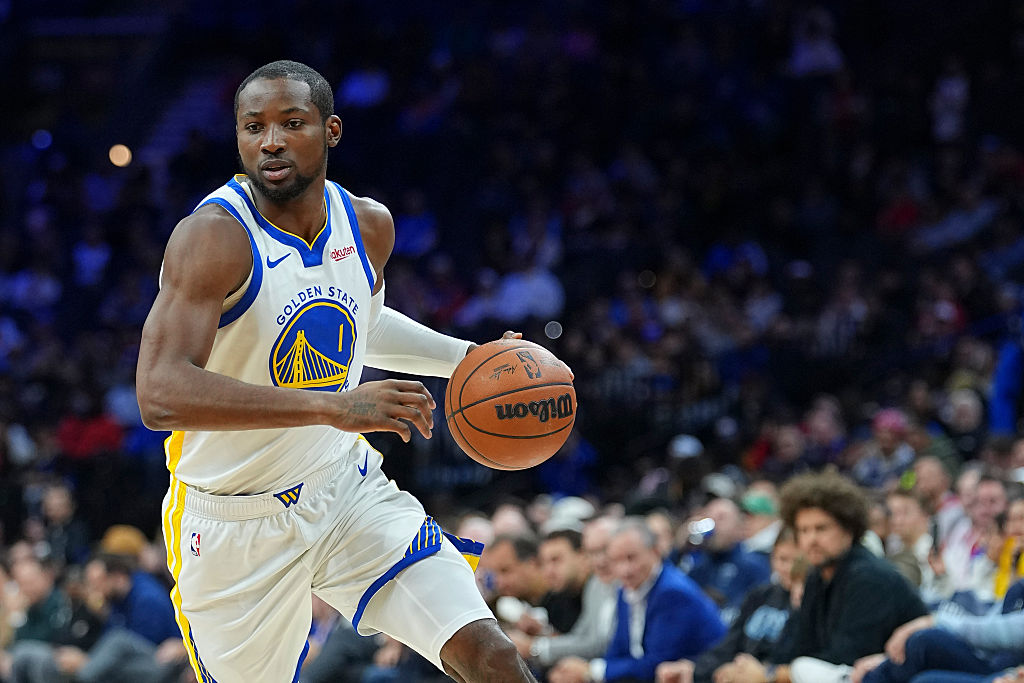
Potential is a word that gets thrown around loosely in NBA circles. Front offices sell it. Fan bases cling to it. Eventually, though, every general manager reaches the same crossroads: deciding whether a player is still ascending or simply nearing what he is going to be. That tension is quietly taking shape between the Los Angeles Lakers and the Golden State Warriors, two franchises operating on different timelines but facing similar questions about roster construction.
For the Lakers, that question centers on Rui Hachimura. Once viewed as a long-term upside play, Hachimura is now 27 and looks largely like a finished product. That is not a criticism. He has established himself as a reliable 3-and-D wing who fits cleanly into playoff rotations and complements star-driven offenses without demanding touches.
Golden State’s dilemma is more complicated. Jonathan Kuminga is just 23 and still flashes the kind of athletic tools teams covet. But his development curve has been uneven, and for a Warriors team trying to remain competitive in a crowded Western Conference, patience is becoming more costly.
That contrast opens the door to a change-of-scenery proposal that would exchange certainty for upside.
The Trade Proposal
Golden State Warriors Receive:
- Rui Hachimura
- Dalton Knecht
- 2032 First-Round Pick (Lottery Protected – LAL)
Los Angeles Lakers Receive:
- Jonathan Kuminga
Why the Golden State Warriors Do the Deal
The Warriors would not be making this move to chase upside. They would be doing it to stabilize their rotation.
Hachimura offers exactly that. He defends his position, spaces the floor, and fits into structured offensive systems without disrupting flow. For a team still trying to win games while balancing aging stars and younger contributors, that dependability matters.
The more developmental piece in the return is Dalton Knecht. Knecht’s sophomore season has been uneven, particularly as his three-point efficiency has dipped after a strong rookie year. Because his value is closely tied to shotmaking, the regression is noticeable. Still, at 24, he remains a bet on shooting mechanics and size rather than raw athletic projection.
Knecht does not have Kuminga’s ceiling, but his floor is higher. For Golden State, that distinction matters. The Warriors are currently hovering in the middle of the Western Conference playoff picture, sitting eighth, where marginal lineup improvements can have an outsized impact on postseason positioning.
Taken together, Hachimura, Knecht, and a future first-round pick represent a pivot away from long-term uncertainty toward more predictable contributors — a reasonable recalibration for a team with limited margin for error.
Why the Los Angeles Lakers Do the Deal
For the Lakers, this proposal is about controlled risk.
There has been internal and external debate about whether Los Angeles would move its 2032 first-round pick, widely viewed as its most valuable remaining future asset. Including it with heavy lottery protections reflects a compromise: enough value to engage Golden State, without fully mortgaging the future.
In the current market, that may be sufficient. This is not a seller’s environment. Teams are cautious, cap sheets are tight, and developmental timelines are shortening. Under those conditions, a young wing like Kuminga is more attainable than his physical profile alone might suggest.
From a basketball standpoint, the fit is logical. Kuminga is averaging 11.8 points, 6.2 rebounds, and 2.6 assists in 24.8 minutes per game this season, with efficiency that remains inconsistent. His 32.0% shooting from three-point range continues to limit his offensive portability, and his overall impact has fluctuated within Golden State’s lineups.
That context matters — but it does not eliminate upside. Playing alongside Luka Dončić changes the calculus. Kuminga would no longer be asked to generate offense on his own. Instead, he could lean into his strengths as a play finisher, cutter, and transition threat with one of the league’s best creators orchestrating the offense. Over time, there is room for growth into a secondary creation role alongside Dončić and Austin Reaves.
That is the bet Los Angeles would be making — not on what Kuminga is now, but on what he could become in a more defined environment.
Bigger Picture
No one knows what Kuminga ultimately becomes. It is easy to assume he is still ascending, but NBA history offers plenty of examples of players who plateau earlier than expected.
If that happens, his long-term utility may trail Hachimura’s. Kuminga does not yet offer the same shooting reliability or lineup portability, particularly for a team with championship aspirations. That risk is real.
But the Lakers are not betting on the median outcome. They are betting on the high end. Kuminga’s athletic tools remain rare enough to justify the gamble, especially when paired with elite playmaking already in place.
If he reaches his potential, the cost will look modest. If he does not, the protections ensure the downside is at least contained.
Latest NBA News & Trade Rumors
- NBA Rumors: Los Angeles Lakers Interested In Golden State Warriors’ Jonathan Kuminga
- NBA Rumor: Dallas Mavericks, Sacramento Kings, Chicago Bulls, Washington Wizards Interested In Trading For Golden State Warriors’ Jonathan Kuminga
- NBA Rumors: Sources: Mavericks Want Young Talent In Anthony Davis Trade, Have Interest In Warriors’ Jonathan Kuminga, Hawks’ Zaccharie Risacher
- NBA Rumors: Sacramento Kings Still Interested In Trading For Golden State Warriors’ Jonathan Kuminga
- NBA Rumors: Dallas Mavericks Trade Proposal Lands Jonathan Kuminga In Swap With Golden State Warriors