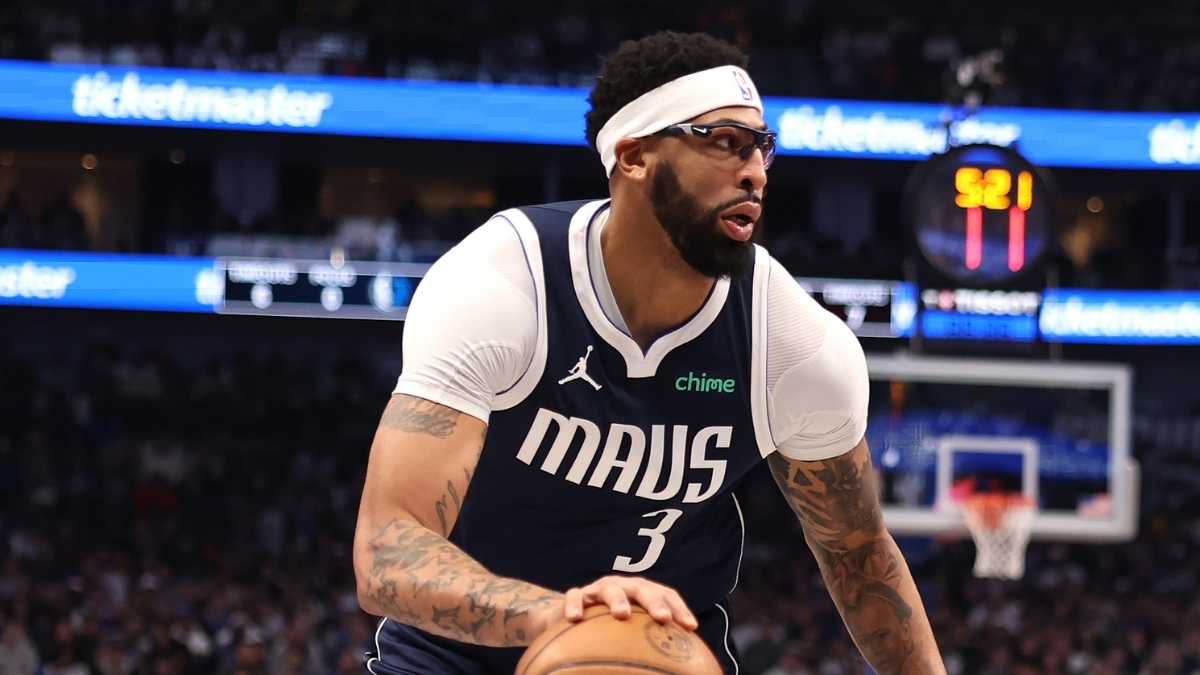
Nearly three months after Nico Harrison was dismissed as general manager, the player he identified as the centerpiece of the Dallas Mavericks’ post–Luka Dončić championship vision is headed to a new destination.
The Mavericks have agreed to trade Anthony Davis, along with Jaden Hardy, D’Angelo Russell, and Danté Exum, to the Washington Wizards, sources tell DallasHoopsJournal.com. In return, Dallas will receive Khris Middleton, AJ Johnson, Malaki Branham, Marvin Bagley III, and a significant package of draft assets.
According to sources, the draft compensation includes a 2026 first-round pick via Oklahoma City, a 2030 first-round pick via Golden State protected 1–20, a 2026 second-round pick via Phoenix, a 2027 second-round pick via Chicago, and a 2029 second-round pick via Houston. The Oklahoma City first-rounder was originally acquired by Washington in the 2024 Daniel Gafford three-team trade.
League sources told DallasHoopsJournal.com the trade came as a surprise even to teams that had previously been linked to Davis, underscoring how little traction ultimately developed once formal talks intensified.
Anthony Davis Trade Market That Never Materialized
By the time serious negotiations began, league sources told DallasHoopsJournal.com there was effectively no meaningful market for Davis. Teams were unwilling to absorb his contract and ongoing injury risk while parting with a blue-chip prospect and significant draft assets, leaving Dallas with limited leverage and few realistic paths forward.
More than anything, league sources perceive the Mavericks as wanting the next general manager to inherit a clean financial and roster slate rather than continue managing the fallout of the Dončić trade.
“This looks like they want to turn the page before the next GM gets there,” one league source said.
One league source characterized the first-round compensation Dallas received as a “fake” first-round pick in terms of immediate value, though acknowledged that the broader return reflected the realities of Davis’ age, availability, and contract structure, but more so the cost of attaching players in this deal with negative value contracts, like Exum, Hardy, and Russell.
“They dumped a lot of salary with a clear focus to create flexibility around [Cooper] Flagg,” one league source said. “If you’re attaching bad deals as they did with AD [Anthony Davis], the value of what you get back in picks is going to come down.”
Washington Wizards’ Calculated Long Game
As the Wizards became increasingly motivated to find a long-term frontcourt partner for Alex Sarr, league sources told DallasHoopsJournal.com that Washington explored multiple options internally. Names such as Walker Kessler and Domantas Sabonis surfaced during those discussions before the front office capitalized on the lack of meaningful traction for Davis around the league.
The structure of the deal reflects the operating philosophy of President of Basketball Operations Will Dawkins, whose Oklahoma City background continues to shape Washington’s approach. Dawkins has consistently leveraged expiring contracts and future cap space to buy low on established players whose value is unlikely to decline further, while preserving meaningful upside if prior production can be reclaimed.
The Wizards’ acquisition of Davis also builds on an earlier trade to acquire Trae Young, with league sources indicating to DallasHoopsJournal.com that both players are viewed internally as longer-term pieces rather than immediate centerpieces. Washington is incentivized to manage their timelines carefully, as the franchise must finish within the top eight of the 2026 NBA Draft order to retain its first-round pick; otherwise, it will convey to the New York Knicks.
As a result, Davis and Young are expected to factor more prominently into the Wizards’ plans for the 2026–27 season, aligning veteran upside with draft-position protection. Sources told DallasHoopsJournal.com there’s an expectation the Wizards will slow-play Davis’ recovery as they have done with Young.
The Dallas Mavericks Gamble That Never Stabilized
Davis was acquired to anchor a new championship window alongside Kyrie Irving, but the pairing never had a chance to take hold. The two played just three quarters together, and Davis never shared the floor with Cooper Flagg, the No. 1 overall pick who has rapidly become the franchise’s focal point.
Even as injuries mounted, Davis remained publicly confident that Irving’s eventual return would elevate the Mavericks once the roster could finally stabilize. In early January, with Irving still sidelined as he continued his recovery from a torn ACL, Davis emphasized patience and the importance of allowing that process to play out.
“Obviously, we want him back,” Davis said of Irving. “He’s coming off a serious injury. Whenever you guys get a chance to talk to him, you can ask him that question. I don’t try to hassle guys about coming back. I ask him how he feels. But to rush him back, especially off an injury like that, you have to be smart.”
Davis also made clear how much Irving’s presence was expected to change the team’s identity.
“Obviously, he is a hell of a player, a Hall of Famer,” Davis said. “He changes the dynamic for our team. When he gets back, we are going to be an even better team.”
That version of the Mavericks, however, never had the opportunity to materialize.
Flagg leads the Mavericks in scoring at 20.1 points per game while also contributing 6.7 rebounds, 4.2 assists, 1.2 steals, and serving as a two-way engine. His emergence reshaped Dallas’ internal timeline and placed a premium on long-term flexibility.
Davis’ tenure in Dallas was defined by interruption. He arrived with an abdominal strain, exited his debut with a left adductor injury, later underwent an offseason procedure to repair a detached retina, and sustained additional setbacks, including a left calf strain, bilateral Achilles tendinopathy, adductor soreness, and ligament damage in his left hand.
When available, Davis remained productive, averaging 20.4 points, 11.1 rebounds, and 1.7 blocks, but availability never stabilized, and he ultimately became the physical embodiment of a franchise-altering gamble that never found footing.
As speculation intensified following Harrison’s dismissal, Davis addressed the trade rumors directly in November.
“Man, look. Y’all make it like we’re going to war or something. This is basketball. It comes with it,” Davis said. “I think everybody in their career has been involved in trade talks, or been traded, or some type of move. That doesn’t affect me. I’ve been in trade talks for a while. My job is to do what I do when I’m on the floor, play basketball, and try to lead this team. Whatever comes out of that, comes out of that.”
Spacing, Pace, and Cooper Flagg’s Expanding Role
League sources told DallasHoopsJournal.com that fit concerns quietly lingered during Davis’ time in Dallas, particularly related to floor spacing and pace. While Davis remained productive individually, some around the team questioned how his presence compressed driving lanes and slowed tempo for a roster increasingly built around movement and decision-making.
Those concerns became more pronounced as Flagg’s role expanded. In 26 career games without Davis, Flagg has averaged 21.2 points, 6.7 rebounds, and 3.7 assists, operating with more space to attack downhill, initiate offense, and dictate pace. Dallas leaned more heavily into Flagg as a primary initiator in Davis’ absence, allowing him to push tempo and operate with fewer constraints in half-court sets.
As league sources told DallasHoopsJournal.com, that evolution helped solidify the organization’s belief that its long-term direction is best served by maximizing Flagg’s usage and spacing the floor around him. There is also a strong belief in Flagg’s ability to make plays not only as a scorer but also as a passer.
Internally, some within the Mavericks have also come to view Flagg as the team’s best passer, not simply a high-usage scorer learning to facilitate, sources told DallasHoopsJournal.com. His vision, willingness to make early reads, and ability to keep the offense moving have increasingly shaped how Dallas evaluates its offensive hierarchy. There is a belief he can handle significant ball-handling responsibility as a focal point, reinforcing confidence that more of the attack can flow through him as the roster continues to evolve.
Those evaluations have also informed how the Mavericks view Irving’s fit alongside Flagg. Irving is regarded as a score-first guard whose efficiency and offensive gravity are maximized when he is not asked to carry constant creation responsibilities, sources told DallasHoopsJournal.com. While Irving is more than capable as a facilitator, doing so requires significant energy, something the organization believes Flagg can mitigate. Pairing him with a wing like Flagg, who can initiate offense, dictate pace, and make reads, is seen as a way to maximize Irving’s impact.
Despite the uncertainty surrounding the roster, Flagg has emphasized that his development has been shaped by the veterans around him, even with injuries limiting their time together on the floor. Asked after the loss to Boston how championship-level veterans such as Davis and Irving have helped him navigate his rookie season, Flagg pointed first to the mental side of growth.
“Mentally, a lot,” Flagg said. “Those guys have been through a ton in this league and in life. A lot of the mental growth I’ve made, I’d attribute to them being there as role models, giving me advice, and helping me navigate everything I’m going through.”
Flagg also acknowledged how much he wanted to see what the roster might have looked like at full strength, even as the team’s direction shifted.
“I’d love to,” Flagg said. “I got to play with AD when he was healthy, and I loved it. He’s a really special player and a really good person. I love sharing the court with guys like that, and hopefully once everyone’s healthy we’ll see what that looks like.”
With the trade deadline approaching, Flagg said the locker room largely avoided dwelling on the uncertainty.
“We honestly haven’t talked about it a ton, which I think is a good thing,” Flagg said. “It hasn’t really been looming around the locker room. What they have said is that it’s a business. They’ve just prepared me for that reality. You never know what’s going to happen, so you just have to stay ready.”
A Financial Reset by the Dallas Mavericks’ Design
For Dallas, the trade is not about replacing Davis’ production. It is about resetting the franchise’s financial architecture.
By moving Davis, Hardy, Russell, and Exum, the Mavericks clear roughly $68 million in 2025–26 salary while taking back approximately $43.6 million in largely expiring money, led by Middleton’s contract. The move drops Dallas below the luxury tax and both aprons for the remainder of this season and leaves the team with roughly $150 million in guaranteed money next year, well below tax and apron thresholds.
At the time of the deal, Dallas was projected to be deep into the luxury tax and over the second apron for the 2026–27 season. League sources told DallasHoopsJournal.com this transaction allows the Mavericks to avoid nearly $200 million in combined salary and tax penalties in that year alone, while restoring flexibility that had all but disappeared.
Just as significantly, Dallas removes more than $112 million in guaranteed future salary tied to Davis’ escalating contract. Davis is also eligible for a contract extension in August, and league sources told DallasHoopsJournal.com the Mavericks were not in a position to provide advance assurances on a new deal given their evolving timeline. As a result, a trade was an outcome that was welcomed.
While the Mavericks will not project to have traditional cap space, the deal reshapes how they can operate. Dallas now holds a newly created $20.8 million trade exception, a separate $6 million trade exception, and is positioned to use a projected $15 million mid-level exception this summer, giving the front office multiple avenues to add talent without reentering apron territory.
Middleton, who is averaging 10.3 points, 3.9 rebounds, and 3.3 assists, does not align cleanly with Dallas’ longer-term timeline and could emerge as a buyout candidate if he remains with the team through the deadline.
Daniel Gafford and Klay Thompson remain the Mavericks’ main remaining trade candidates, sources told DallasHoopsJournal.com, while Gafford — despite his recurring right ankle issues — has drawn interest from multiple teams. However, while Dallas could continue to do business before the deadline, the improved financial outlook reduces the urgency to shed salary. Gafford has averaged 8.1 points, 6.6 rebounds, and 1.3 blocks, while Thompson has transitioned into a reduced role at 11.6 points per game in just over 22 minutes.
Dallas Mavericks Are Clearing the Deck Completely
Internally, Russell and Exum were viewed as sunk costs. Russell’s contract was widely considered a flop, and Dallas was intent on moving him before he could exercise his $6 million player option. It was fully expected around the league that he would be traded if any viable path emerged. He was out with illness for Tuesday’s game against Boston and was not seen.
Dallas also faces roster mechanics beyond the trade. The Mavericks are nearing the games-played limit on their two-way contracts for Moussa Cissé and Ryan Nembhard. Nembhard leads the team in assists at 4.8 per game, but converting either player to a standard deal would still require clearing an additional roster spot. League sources have told DallasHoopsJournal.com that Dallas views both players as candidates for a standard conversion depending on the circumstances.
In less than a year, Davis’ tenure in Dallas opened with championship ambition and closed with a salary dump. The Mavericks now possess additional first-round picks, meaningful financial flexibility, and a roster clearly oriented around Flagg, who leads the team in scoring, while shaping both ends of the floor.
Everything now shifts toward a new timeline — one centered on development, asset accumulation, and a front office still to be formally installed.
The Anthony Davis era is over. For Dallas, the reset is complete.
This article will be updated as more information is made available.
Latest Dallas Mavericks News & NBA Rumors
- NBA News: D’Angelo Russell, Brandon Williams Ruled Out As Dallas Mavericks Face Boston Celtics
- NBA News: Cooper Flagg’s January Dominance Earns Third Straight Rookie Of The Month Honor
- NBA News: Dallas Mavericks Coach Jason Kidd Fined $35,000 For Public Criticism Of Officiating, Profane Language
- NBA News: Dallas Mavericks Rookie Cooper Flagg Becomes Youngest Player With Back-to-Back 30-Point Double-Doubles
- NBA News: ‘I Know What The Fuck I’m Doing’: Jason Kidd Explodes Over No-Call, Criticism After Loss To Houston Rockets
- NBA News: ‘I Saw A Foul’: Dallas Mavericks Fume as Fourth Straight Loss Slips Away Against Houston Rockets
- NBA News: ‘You Saw History’: Cooper Flagg’s 49-Point Night Collides With Late Turnover As Dallas Mavericks Fall To Charlotte Hornets